Saturday, May 14, 2011

Warring Tribes Join Forces To Fight Smut!

"Pornography is now considered as addictive as drugs"
- Rev. Jimmy Swaggart
Katie: The internet is really really great,
Trekkie Monster: For porn!
Katie: I've got a fast connect, so I don't have to wait!
Trekkie Monster: For porn!
- From "The Internet Is For Porn" by Robert Lopez and Jeff Marx
It is hard to think of a time when pornography was not in the news. When the navy seals found Bin Laden, they found a stash of pornography in his lair. Several weeks ago, Sen. Orrin Hatch sent a letter to Attorney General Eric Holder demanding more obscenity prosecutions. Going back to the 1980's, Ronald Reagan's Attorney General Ed Meese created a Commission on Pornography. A presidential commission on pornography was assembled in the late 1960's, but when this commission recommended legalization, then President Richard M. Nixon rejected the commission's findings. In the mid-sixties, financier Charles Keating (a man who later had his own ethics issues) bankrolled an anti-pornography drive.

The most interesting anti-smut movement in my lifetime was the Women Against Pornography group formed in the late 1970's. Before this group was formed, most of the support for obscenity laws came from conservative religious groups. These early Christian right groups used to argue that pornography should not be given first amendment protection because it subconsciously alters the mind, causing both addiction and a host of anti-social behaviors. Reverends Pat Robertson, Jimmy Swaggart, Jerry Falwell etc. asserted that if pornography were legal, we would see a dramatic increase in rape, adultery, divorce, teen pregnancy and wife beating.

I was in college in the 1970's, and there was strong support for civil liberties and free speech on the campuses of that era. That ended with the arrival of Women Against Pornography, a group founded to advance the work of feminist authors Andrea Dworkin and Catharine McKinnon. Dworkin and McKinnon argued that smutty books, magazines and films, and even publications as innocuous as Playboy were a crime against women. What I found remarkable about this group's arguments on the porn issue was how close it was to the case made by the religious right. These feminists said that pornography had special mind-altering properties, that pornography is like an addictive drug, and that it causes a plague of social ills. Attending one of their rallies, I felt like I was hearing Jimmy Swaggart and Jerry Falwell dressed up in drag (sorry for that rather unpleasant imagery). To be fair, the anti-porn feminists did come up with one argument not previously made by the religious right: they argued that porn convinces men that women are only good for sex, and hence porn consumers will not accept females in professional positions. I didn't find this argument convincing, but at least it was original.

Amazingly enough, this group had a profound impact on college campuses. I was astounded with how many students and professors did a 180 degree turn on obscenity laws, and doing so on the basis of arguments that were soundly rejected a few years ago. It was not as though everyone had just discovered the genius of Pat Robertson. So what happened to the ideals, such as free speech, civil liberties, and sexual freedom, that we used to share? This experience demonstrated an important principle. Although most people think that their political / social / religious views are shaped by their ideals, what really shapes their views is group identity, also known as tribalism. They feel the pressure to conform with the prevailing opinion of the social group that they are members of. The Women Against Pornography story is really about one tribe (feminists) joining forces with an enemy tribe (the religious right) in order to fight a common enemy, smut peddlers. And as a committed civil libertarian, I found it appalling that this would be the issue that brought these sides together.

Fortunately, Women Against Pornography disbanded in the late 1980's, so now only the social conservatives carry on the battle against smut. The right has lost a lot of its enthusiasm over this issue: if P. J. O'Rourke and Greg Gutfeld got together to discuss porn, they'd probably end up talking about where to find the really good stuff. But frankly, this issue was settled in the 1990's with the invention of the internet. The internet made pornography more available than ever. If there was anything to the right (or left) case against porn, then the rise of the on-line community would have been accompanied by large increases in rapes, divorces, teen pregnancies, etc. But as this Hit and Run post pointed out, all of these social ills have actually lessened since 1991.

To this, I would add that the internet also disproved the theory that porn consumers could not accept that women can be good for something besides sex. Since web browsing hit the big time, women have been swelling the ranks of many professions. And as a man, I am happy to report that the popularity of the Chippendales has not produced a hoard of women who think that men are only good for the full monty.

Tuesday, March 22, 2011

When Will We See War Declared the Right Way?

Did Obama get advice from THESE guys?
"The Congress shall have Power... To declare War, grant Letters of Marque and Reprisal, and make Rules concerning Captures on Land and Water;"
- Section 8 of the U.S. Constitution

"Then it’s war!
Freedonia’s going to war!
Each native son will grab a gun.
And run away to war!"
- From "The Country's Goin' to War" by Bert Kalmar and Harry Ruby;
Pundits have criticized the U.S. bombing of Libya for its ill timing, its lack of planning, and for the fuzzy end goals. As serious as these issues are, there is an even bigger problem with this military action: is it constitutional? According to section 8 of the constitution, the power to declare war resides with congress. The decision to set up a no-fly zone was made without a vote in the house or the senate, or even consulting with most Senators and Representatives for that matter.

Does the President have the constitutional power to do this? Voices as disparate as Rep. Dennis Kucinich (D-OH) and Rep. Ron Paul (R-TX) agree that this action is clearly a violation of Obama's oath to uphold the constitution. In fact, some feel that this is an impeachable offense. One former Senator and presidential candidate said in 2007, that if then President George Bush unilaterally took military action against Iran, he would move to impeach him. That candidate was Sen. Joe Biden, our current Vice President.

In December 2007, the Boston Globe asked the Presidential candidates
"In what circumstances, if any, would the president have constitutional authority to bomb Iran without seeking a use-of-force authorization from Congress? (Specifically, what about the strategic bombing of suspected nuclear sites -- a situation that does not involve stopping an IMMINENT threat?)"
Candidate Barack Obama's response started with
"The President does not have power under the Constitution to unilaterally authorize a military attack in a situation that does not involve stopping an actual or imminent threat to the nation."
Absolutely correct, candidate Obama! Now can you please impart this constitutional expertise to President Obama?

To be fair, section 8 of the constitution has been ignored for many administrations. The last American war officially declared by congress was before the Korean war! The U.S. has not fought a war as proscribe by the constitution in my lifetime, and I fear that I might not live to see a constitutionally declared war. But previous presidents have at least had some sort of congressional vote to approve wars that did not involve a threat to the nation. Obama has crossed a new threshold with the Libyan no-fly zone.

Instead of waiting for congressional approval, our President acted on the approval of two other bodies: the United Nation and the Arab League. This is troubling for reasons other than the fact that these bodies have zero congressional authority: neither of these bodies are elected by U.S. citizens. War can impact U.S. foreign relations for generations. The cost of American wars is born by U.S. taxpayers. Our wars also kill many of the our best young people. Given the burden on U.S. citizens, shouldn't war decisions be made by a body elected by these citizens?

The wars in Afghanistan and Iraq are being fought, in part, to bring democracy to those countries. But who's fighting to bring democracy to America?

Friday, March 11, 2011

The Machinery of Egyptian Freedom


"Then said Jesus to those Jews which believed on him, If ye continue in my word, then are ye my disciples indeed; and you will know the truth, and the truth will set you free.”
- John 8:31-32
"Harmony and understanding
Sympathy and trust abounding
No more falsehoods or derisions
Golden living dreams of visions
Mystic crystals revelations
And the mind's true liberation
Aquarius...
Aquarius!”
- From "Age of Aquarius" by James Rado, Gerome Ragni and Galt Macdermot
Hosni Mubarak's brutal repression of protesters proved to virtually everyone except Vice President Joe Biden that he was a dictator. And like many dictators before him (Shah Mohammad Reza Pahlavi, Idi Amin, Bébé Doc, Ferdinand Marcos, Nicolae Ceaușescu, Augusto Pinochet and Mobutu Sese Seko, just to name a few), his own people forced his exit from power. But there is something extraordinary about the overthrow of Mubarak: he was forced out with very little real or threatened violence. In contrast to their government, the Egyptian protesters were astonishingly peaceful.

How did the protesters prevail without engaging in thuggery? The answer may be found in the 1973 book "The Machinery of Freedom" by David Friedman (son of economist and Nobel prize winner Milton Friedman). In this book, David Friedman makes the case for a much smaller government, replacing most forms of state coercion with voluntary arrangements. I learned a lot from this book, even though I do not subscribe to Friedman's rather extreme form of libertarianism. "The Machinery of Freedom" forces the reader to reflect on the assumptions we often make about the need for government power. No wonder that this book made Australia's Institute of Public Affairs list of 20 books that you must read before you die.

Two chapters of this book are quite apropos to the current middle east revolts. In "Revolution is the Hell of It", Friedman rejects violent revolution as a tactic to produce a libertarian state. Violence is counterproductive violation of libertarian principles. The final chapter, "How to Get There From Here", proposes a peaceful alternative to revolution: undermining the state's legitimacy. Even in the worst dictatorships, government power derives mostly from the majority of the population believing in the legitimacy of their leadership. They may dislike their leaders, but they think that only the current leaders can run their country, and that without these leaders, their nation would descend into chaos. As the Milgram experiments demonstrated, the pressure of group conformity can reinforce such a viewpoint. Friedman felt that an overbearing state could be reigned in through a combination of education and demonstration, convincing citizens that they can run their country without sacrificing their freedoms. As Lennon and McCartney wrote in the song "Revolution", "You better free your mind instead".

Is this recipe for peaceful overthrow of a tyrannical state too optimistic? I certainly thought so when first read this book. But consider what happened in Egypt. In a very short period, Mubarak's legitimacy vaporized. Shahira Amin, one of Nile TV' most popular journalists, abruptly quit because her network would only present government propaganda, a violation of her journalistic principles. In the days before Mubarak stepped down, there were a sizable number of policemen that refused to take action against the protesters. So somehow, the Egyptians pulled off Friedman's Utopian vision of how to end government repression.

I doubt that this kind of revolt could have happened in 1973. What made it possible today is a technical breakthrough: social networking. Earlier this year, an Egyptian blogger posted a video of police rape and torture of dissidents. And as Mubarak supporters learned, once a video hits the internet, it never disappears. This video, along with unrest in Tunisia, became popular Facebook topics. Opponents of Mubarak saw that they were not alone in their concerns. Facebook also turned out to be an excellent organizing tool. Recognizing the threat, the government tried cutting off internet access (is that the reason why there is talk in Washington about an internet kill switch?), but the dissidents found ways around this, including going back to dial-up access to foreign internet providers. So remember folks, don't throw away those 56K modems!

From the start of the Mubarak regime until shortly before his downfall, the various U.S. administrations have been solidly behind him. For that reason, it is hard to find an Egyptian protester with a positive word for an American Politician. There is an American, however, who is spoken of quite highly by these protesters: Mark Zuckerberg, founder of Facebook. If anybody gets a Nobel Peace Prize for the handling of the Egyptian crisis, it should be Zuckerberg, but unfortunately it will probably go to some politician instead. But history will remember that Facebook was a very important part in the Egyptian machinery of freedom.

Saturday, March 5, 2011

Crossing the Board Game / Electronic Game Divide


"You have to learn the rules of the game. And then you have to play better than anyone else."
- Albert Einstein

"I think it's wrong that only one company makes the game Monopoly."

- Steven Wright

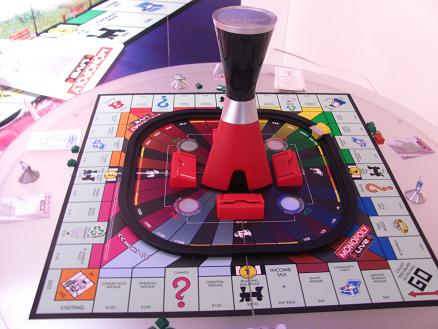
Video games have dominated the entertainment industry for the last few decades. The video games' older analog equivalent, the board game, has lost favor during this period. The number of board games sold last year was down 10% from the year before. In an attempt to reverse this decline, Hasbro will be releasing hybrid electronic / board games this fall. The first of these will be "Monopoly Live", followed by "Battleship Live".

The Monopoly Live board has a battery powered computer control tower at its center that guides the players through the game. Hasbro contends that this tower's guidance allows a new player to start playing right away without having to first study the rules. The tower provides the following services:
  • It takes on the thankless job of banker;
  • It computes taxes and mortgage fees;
  • It rolls the dice;
  • It reads the Chance and Community Chest cards (with appropriate sound effects);
  • It manages the money electronically (players have ATM cards); and
  • It runs additional games events such as auctions, horse races and tax audits.
A demo of Monopoly Live can be seen here.

Needless to say, there are purists who object to this merger of traditional gaming and electronics, defending the superiority of analog-based fun. Now I don't dispute that traditional board games can be a lot of fun. When I was a child, video games had not been invented, so my family had fun with classic board games Operation, Mousetrap, Monopoly, Life, Clue, Checkers, Chinese Checkers, and Bridge-It, as well as sadly forgotten games such as Careers and Masterpiece.

But even with these fond memories for the traditional board games, I do not reject the Live board game concept. First of all, the golden age of board games is overrated. When studying the history of a cultural phenomena, such as shopping malls, comic books, network TV, and even retro video games, one often ends up romanticizing the past. One tends to remember the successes and forget the failures. As one who lived through that era, I can vouch that for every classic board game, there were dozens of dull, uncreative games that were not worth playing once. Most of the worst board games were TV or movie tie-in games (The same thing could be said about video games). Our neighbors had a "Dick Tracy" game that was so bad, the only way we managed to have fun with it was to figure out how we could make a good game out of the game board and pieces. Note: if anyone knows of a ROM hacker who has succeeded in making a good video game out of a bad one, please tell us about it in the comments.

These "Live" games will not be the first time that electronics have promoted a board game. Two classic strategy games, Chess and Go, are probably more popular now than any time in history, thanks to the fact that one can play virtually any opponent on the planet in real time, using an internet connection. Computers almost certainly saved the game Othello from extinction. Othello is a much older game than most people realize: it was originally published as Reversi in nineteenth century England. For many decades after its invention, Reversi was known only to a small but enthusiastic group of strategy game enthusiasts. It was not until a PC version of the game, under the name Othello, that the game finally attracted a large following. There are Othello leagues in many nations, as well as international competitions. I doubt if you would be able to buy an Othello set at most game stores if it were not for the PC game.

Computers have made our work life much easier. Since the invention of the Monopoly game, file cabinets have been replaced by databases, typewriters have been replaced with word processors, checks have been replaced with electronic transfers, and postage meters have been replaced with E-mail. All of these changes allow us to do a better job with less effort. But if electronics can make our work life easier, why not use this same technology to make our gaming easier, especially since gaming is supposed to be a recreational activity?

Finally, keep in mind that the point of a board game, or any game for that matter, is to have fun, and these Live games look like they'll be a blast. I'm hoping they are working on a "Clue Live" where the tower gives voice to a detective that sounds like Basil Rathbone.

Sunday, February 20, 2011

Texas School Children: Give Choice a Chance

"Liberty, according to my metaphysics is a self-determining power in an intellectual agent. It implies thought and choice and power."
- John Adams
"Teach, your children well
Their father's hell
Did slowly go by
And feed them on your dreams
The one they pick's
The one you'll know by."
- From "Teach Your Children" by Graham Nash.
In this third and final post on the Texas school districts that discipline students using the legal system, I would like to focus on one incident from the Texas Appleseed report that exposes the root of many of the problems with American public education:
"A 17-year-old girl with autism became frustrated [in class]. The teacher who best understood how to manage her behaviors was off work that day. The substitute did not know how to respond and accidentally escalated the situation by talking loudly and getting close to the student. The young lady left the classroom without permission, cursed and then sat in the hallway rocking back and forth to calm herself. When the assistant principal heard what happened, he asked a police officer to write a citation for Disruption of Class. The young lady’s single, low-income mother came to the school to talk to the vice principal, explaining that her daughter did not have full control of her behavior and was not able to understand the citation. She also explained she could not pay for citations. The vice principal told the mom that if she did not want her daughter to get more citations, she should withdraw the daughter from school because she was old enough to drop out."
As the father of an autistic son, I find this incident especially appalling. One's first impression is to blame the vice principle for this injustice, but the problem goes beyond this one employee. True, the vice principle did not act in the student's best interest, but he did act in the school's best interest. But why does the school's best interest differ from those of the students? This perverse incentive system is a result of the lack of choice on the part of the student.

In most circumstances, most American public school students have no choice as to which school to attend. Moreover, school financing is generally based on the number of school aged children in the district, not on how many students actually attend the school. The school's budget is not negatively affected by their students switching to private education or home schooling.

We can empower student's families with a change to the way we finance public schools. Instead of allocating education money to the schools, we could these funds to the child, with additional public funds provided for students with special educational needs. The family would then choose which public school their child would attend, and then that school would receive the funding for educating that child. School that attracts more students would receive more financing, schools that loses students would be forced to tighten their belts. Under such a system, could you imagine a vice principle recommending that a student drop out?

Would the Texas system of legal fines for school offenses such a cursing, talking back and skipping classes be adapted in a school choice system? As we have seen, this system has been particularly harsh with racial minorities and the handicapped. These students would undoubtedly exercise their choice for a school that takes a more humane approach to discipline. No family would be forced to endure the Texas ticketing system.

School choice is not just an academic theory. It is practiced in Belgium, France, Sweden, Chile, Ontario, and New Zealand. The countries where choice has been tried get better student test results than American public schools, and get those results at lower cost. This is the unsurprising consequence of families choosing the schools that works best for their children.

When we buy a product like breakfast cereal or a laptop, we insist on having a choice between several providers in order to get the best product. And yet we settle for no choice in a much more important matter: the education of our next generation. Our children deserve better; they deserve a choice.

One final note: my autistic son Jonathan has his own blog, as well as his own YouTube account. He may be constrained by his condition, but that never stops Jonathan from making the most of what he can accomplish. This is what I admire most about him.

Friday, February 18, 2011

Texas School Children: Flex Your Rights!


"The right of the people to be secure in their persons, houses, papers, and effects, against unreasonable searches and seizures, shall not be violated, and no Warrants shall issue, but upon probable cause, supported by Oath or affirmation, and particularly describing the place to be searched, and the persons or things to be seized."
- Amendment 4 to the U.S. Constitution
"In 1787 I'm told Our founding fathers did agree
To write a list of principles For keepin' people free"
- From "Preamble", written by Lynn Ahrens for "Schoolhouse Rock"
This site's previous post discussed how some Texas school districts are now enforcing discipline using the criminal justice system. As noted in the Texas Appleseed report, this overly severe form of punishment poses a burden on poor families, is unfair to racial minorities, and adds to the already considerable challenges facing handicapped students. Is there any bright side to this criminalization of student behavior?

Yes there is. The ticketing of Texas students gives us an ideal platform to teach our children the importance of the U.S. constitution. Sadly, most adult Americans are quite ignorant of the workings of our democracy, especially our constitution. Civil libertarian Steven Silverman was shocked to discover how often people would unknowingly waive their constitutional rights, so in 2002 he founded the non-profit educational organization Flex Your Rights to educate the public on their constitutional protections. Flex Your Rights produced the video BUSTED: The Citizen's Guide to Surviving Police Encounters, which I heartily recommend.

Our schools have been doing a poor job of teaching the constitution. I would recommend that we work with the Flex Your Rights folks to develop a course on the constitution for Texas students. If the Texas school systems refuse to teach the constitution, perhaps Texan libertarians could present constitution lessons outside of school system (think of it as a Texan version of Dumbledore's Army). Armed with the Flex Your Rights curriculum, Texan students could both protect themselves from the excesses of the ticketing system and learn a valuable civics lesson in the process.

For example, the Appleseed report tells of a girl who was given a $200 ticket when a school officer searched her purse and found a cigarette butt. Had she known about the fourth amendment, she would have known that the search could almost certainly be prevented if she politely but clearly told the officer "I do not consent to a search of my purse". Unless the officer has a warrant for searching her purse, any search of her purse would be illegal, the cigarette butt could not be admitted as evidence in court, and the school officer could be be held liable for the illegal search.

The most effective learning technique is to learn by doing. Imagine what students would learn about civics by actually applying the Flex Your Rights curriculum for their own protection. This whole affair could have one really positive effect: a generation of Texas students with a full appreciation of our founding documents.

Wednesday, February 16, 2011

Texas School Children: Another Brick in the Wall


"I found one day in school a boy of medium size ill-treating a smaller boy. I expostulated, but he replied: 'The bigs hit me, so I hit the babies; that's fair.' In these words he epitomized the history of the human race."
- From "Education and the Social Order" by Bertrand Russell
"When we grew up and went to school, there were certain teachers who would hurt the children anyway they could
by pouring their derision upon anything we did
exposing every weakness however carefully hidden by the kids."
- From "Another Brick in the Wall" by Pink Floyd.

Bullying is major problem in many of our schools. Sometimes, the worst bullies are the grown-ups. A case in point is a novel form of discipline now practiced in several Texas school systems, including Houston, Austin, San Antonio and Dallas. Instead of detention to punish misbehaving students, the school system is using the criminal justice system. A student who disobeys a school rule is given a ticket that his or her family has to pay. Last year, more than 275,000 Texas juveniles were ticketed for such offenses as disrupting class, disorderly conduct or curfew violations (i.e. leaving campus without permission). These tickets are not cheap; when school officials searched a girl's purse and found a cigarette butt, she got a ticket for $200! Some troubled students can rack up several tickets, placing a substantial financial burden on their family.

These tickets have to be taken seriously. These violations are class C misdemeanors, which is serious enough to show up on a criminal record. Of course, a Texas child's criminal record should be wiped clean of these offenses once he or she turns 18, but due to the sheer volume of these tickets, this often isn't done. It gives a whole new meaning to the term "permanent record", doesn't it? Moreover, once a student turns 17, he / she can be arrested for failure to pay the ticket. This actually happened to a 17 year old student from Hidalgo county last year.

The public interest group Texas Appleseed has studied the ticketing of students. Among their findings were:

  • tickets were given to children as young as six;
  • racial minorities receive a disproportionate number of tickets; and
  • a student is much more likely to get a ticket if he / she has a disability.

What is especially appalling about this ticketing is that frequently no allowances are made for when a misbehavior might be caused by a disability. Tickets for using profanity have been given to students suffering from Tourette Syndrome! The Appleseed report has a particularly callous citation of an autistic girl. In the interest of full disclosure, I have an autistic son who has his own blog, making this sort of abuse even more disturbing to me.

All in all, this ticketing system recalls the protest song "Another Brick in the Wall" from Pink Floyd's 1979 Rock opera "The Wall". This song condemns the British school system of enforcing mindless conformity by humiliating any student that deviates from the norm. What better anthem is there for school systems that punishes students for the crime of being born with a disability?

So what should be done to stop this legal harassment of Texas children? I have two proposals that I will present in follow-ups to this post. Stay tuned.

A bonus video: here's a version of "Another Brick in the Wall" that might be more appropriate for Texas.