Showing posts with label First Amendment. Show all posts

Saturday, October 15, 2011

Occupy Boston Versus What Occupies Mayor Menino's Soul

"Men at some time are masters of their fates:
The fault, dear Brutus, is not in our stars,
But in ourselves, that we are underlings."
- From "The Life and Death of Julies Caesar", Act I Scene II

"Take a step outside yourself
Then you turn around
Take a look at who you are
It's pretty scary"
- From "Turn Around" (1980) lyrics by Mark Mothersbaugh and Gerald Casale
The "Occupy Wall Street" movement has spread to many big cities, including Boston. Recently Boston Mayor Thomas Menino has ordered the arrests of "Occupy Boston" protesters. On the surface, the Mayor has some valid charges: the protest was spilling over onto the Rose Kennedy Greenway, in violation of zoning rules. The protests have disrupted commercial activity. In particular, a lucrative food festival was cancelled because the protesters had taken over the space where the event would have taken place. Yes, we have the irony that an event that would have provided a lot of temp jobs was cancelled so that people could protest unemployment.

But cry no tears for the his honor the Mayor. The blame for the current lawlessness goes beyond the young people he is arresting. The true cause of the "Occupy Boston" controversy can best be explained by the following facts about Massachusetts politics:
  1. Massachusetts is basically a one-party state, so much so that almost all elections are considered over after the Democratic primary;
  2. This lack of any political challenge has created unusually powerful and long tenured public officials; and
  3. Perhaps because of facts 1 and 2, the commonwealth of Massachusetts has suffered more than her fair share of government corruption (the last three House Speakers are all convicted felons).
Mayor Menino is the archetypical Massachusetts politician. First elected in 1993, Menino has rarely encountered more than token opposition in subsequent elections. He is popular for taking a no-holds-barred approach to the challenges of the office, often at the expense of our constitutional rights.

In 2005, there was a popular line of tee shirts emblazoned with the words "Stop Snitchen'". Menino condemned these shirts as discouraging cooperation with the police. When some Boston stores wanted to sell these shirts, the Mayor vowed to send officers into the stores to seize the shirts. Menino was advised that such a seizure would raise free speech issues, so he tried another tact. City inspectors discovered (who knew?) that the clothing stores that wanted to carry the shirts (and only those stores) had code violations. And once the orders for "Stop Snitchen'" shirts were cancelled, the inspectors found that these stores were up to code after all! Score 1 for Mayor Menino, 0 for the first amendment.

In January of 2007, the Mayor was rightly concerned that after an AFC playoff game, Patriot fans might engage in violence. The Mayor felt that TV news coverage of sports bars might inflame the fans. Lesser men might have urged TV newscasters to be cautious, but not our Honor the Mayor. With all the boldness of a honey badger, he told the Boston bar and tavern owners, a group that is even more under the city's thumb than clothing stores, to not allow TV crews into their establishments. With the fear of losing their precious liquor licenses, TV journalists were shut out of Boston bars. So much for an independent fourth estate; it's good to be the king.

When the Tea Party demonstration (the recent one, not the 1773 party) took place in Boston, the Mayor insisted that they needed permits and that they need to pay a substantial fee to cover expenses that Boston might incur. The idea that we have to get permits and pay fees in order to exercise our constitutional right to assemble is problematic, but there is an even more disturbing aspect to the Boston protest permit and fees system. Before "Occupy Boston", Mayor Menino enthused over the ideas that the protestors would be advancing. So unlike the Tea Party, no permits or fees were required of the Occupy Boston organizers. Civil rights attorney Harvey Silverglate, founder of the campus free speech organization F.I.R.E., is appalled that these fees and red tape are applied at the whims of the Mayor, even though he sympathizes with "Occupy Boston". This is not about protecting city finances: in police overtime alone, "Occupy Boston" has far exceeded all expenses related to the Tea Party event. This is about directing the city's finances to the political causes that the Mayor favors. These arbitrary fees and permits represent a new low in the abuse of power, even by Bay State standards.

So even after giving the "Occupy Boston" people a pass, his honor the Mayor is miffed that the demonstrators circumvent or ignore the laws that they don't like. Sorry Mayor, you do not have my sympathy. If you want Bostonians to show more respect for the law, you should model that behavior by showing some respect for the most important set of laws for our government officials: the U.S. constitution. The constitution asserts that all of us, as part of our basic nature, have certain inalienable rights, including the right to free speech and to assemble. Mayor Menino, could your persistent violations of the spirit, if not the letter, of the first amendment be viewed by the young men and women protesting that the law is not worth taking seriously? If the Mayor were to ask the arrested protestors where they learned to disrespect the law, they could justifiably respond with the 1980's Ad line, "I learned it from watching you!".

For the lighter side of Thomas Menino, check out the Official Mumbles Menino web site. The mayor speeches are filled with many inadvertent malaprops, spoonerisms, and novel phrasing, so the news commentators that cover them often have to do double duty as cryptographers. It appears that he has as much trouble with his own speech as he has with others. The "Mumbles Menino" site includes the funniest and / or most WTF Menino utterances.

On the heavier side of Tom Menino, in recent years he has suffered from significant weight gain. Imagine an overweight autocratic leader who speaks in a way that many people find hard to understand. That image seems familiar; I think I remember where I've seen it:

Saturday, May 14, 2011

Warring Tribes Join Forces To Fight Smut!

"Pornography is now considered as addictive as drugs"
- Rev. Jimmy Swaggart
Katie: The internet is really really great,
Trekkie Monster: For porn!
Katie: I've got a fast connect, so I don't have to wait!
Trekkie Monster: For porn!
- From "The Internet Is For Porn" by Robert Lopez and Jeff Marx
It is hard to think of a time when pornography was not in the news. When the navy seals found Bin Laden, they found a stash of pornography in his lair. Several weeks ago, Sen. Orrin Hatch sent a letter to Attorney General Eric Holder demanding more obscenity prosecutions. Going back to the 1980's, Ronald Reagan's Attorney General Ed Meese created a Commission on Pornography. A presidential commission on pornography was assembled in the late 1960's, but when this commission recommended legalization, then President Richard M. Nixon rejected the commission's findings. In the mid-sixties, financier Charles Keating (a man who later had his own ethics issues) bankrolled an anti-pornography drive.

The most interesting anti-smut movement in my lifetime was the Women Against Pornography group formed in the late 1970's. Before this group was formed, most of the support for obscenity laws came from conservative religious groups. These early Christian right groups used to argue that pornography should not be given first amendment protection because it subconsciously alters the mind, causing both addiction and a host of anti-social behaviors. Reverends Pat Robertson, Jimmy Swaggart, Jerry Falwell etc. asserted that if pornography were legal, we would see a dramatic increase in rape, adultery, divorce, teen pregnancy and wife beating.

I was in college in the 1970's, and there was strong support for civil liberties and free speech on the campuses of that era. That ended with the arrival of Women Against Pornography, a group founded to advance the work of feminist authors Andrea Dworkin and Catharine McKinnon. Dworkin and McKinnon argued that smutty books, magazines and films, and even publications as innocuous as Playboy were a crime against women. What I found remarkable about this group's arguments on the porn issue was how close it was to the case made by the religious right. These feminists said that pornography had special mind-altering properties, that pornography is like an addictive drug, and that it causes a plague of social ills. Attending one of their rallies, I felt like I was hearing Jimmy Swaggart and Jerry Falwell dressed up in drag (sorry for that rather unpleasant imagery). To be fair, the anti-porn feminists did come up with one argument not previously made by the religious right: they argued that porn convinces men that women are only good for sex, and hence porn consumers will not accept females in professional positions. I didn't find this argument convincing, but at least it was original.

Amazingly enough, this group had a profound impact on college campuses. I was astounded with how many students and professors did a 180 degree turn on obscenity laws, and doing so on the basis of arguments that were soundly rejected a few years ago. It was not as though everyone had just discovered the genius of Pat Robertson. So what happened to the ideals, such as free speech, civil liberties, and sexual freedom, that we used to share? This experience demonstrated an important principle. Although most people think that their political / social / religious views are shaped by their ideals, what really shapes their views is group identity, also known as tribalism. They feel the pressure to conform with the prevailing opinion of the social group that they are members of. The Women Against Pornography story is really about one tribe (feminists) joining forces with an enemy tribe (the religious right) in order to fight a common enemy, smut peddlers. And as a committed civil libertarian, I found it appalling that this would be the issue that brought these sides together.

Fortunately, Women Against Pornography disbanded in the late 1980's, so now only the social conservatives carry on the battle against smut. The right has lost a lot of its enthusiasm over this issue: if P. J. O'Rourke and Greg Gutfeld got together to discuss porn, they'd probably end up talking about where to find the really good stuff. But frankly, this issue was settled in the 1990's with the invention of the internet. The internet made pornography more available than ever. If there was anything to the right (or left) case against porn, then the rise of the on-line community would have been accompanied by large increases in rapes, divorces, teen pregnancies, etc. But as this Hit and Run post pointed out, all of these social ills have actually lessened since 1991.

To this, I would add that the internet also disproved the theory that porn consumers could not accept that women can be good for something besides sex. Since web browsing hit the big time, women have been swelling the ranks of many professions. And as a man, I am happy to report that the popularity of the Chippendales has not produced a hoard of women who think that men are only good for the full monty.

Friday, December 31, 2010

Why the Fairness Doctrine is Unfair to the Left


"Error of opinion may be tolerated where reason is left free to combat it."
- Thomas Jefferson, First Inaugural Address, 04 March 1801
"So let's leave it alone, 'cause we can't see eye to eye.
There ain't no good guys, there ain't no bad guys.
There's only you and me and we just disagree."
- From "We Just Disagree" by Billy Dean
The absolute worst laws are passed as a quick response to a crisis. In a heightened sense of urgency, lawmakers are willing to pass some extreme, simplistic solution whose faults become apparent only after the crisis has passed. The 9/11 attacks gave us the PATRIOT act and the TSA, and our civil liberties have suffered ever since. In 2008, the housing bust was addressed with two complex, obscenely expensive and hastily composed programs, the stimulus package and TARP. These programs did not prevent a severe economic downturn, and will be paid for by generations born long after this crisis has passes.

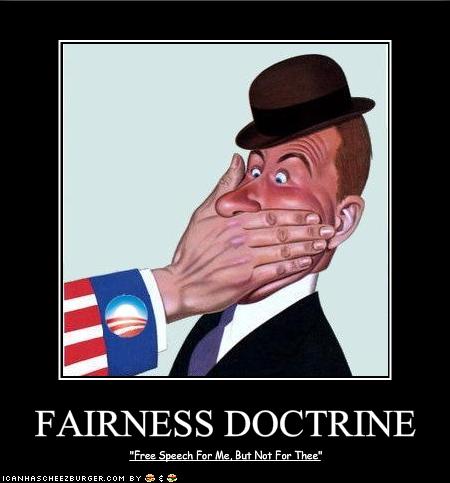
Which brings us to the latest crisis: the tragic shooting in Tucson, Arizona of Rep. Gabrielle Giffords and others. The instant analysis of the shooter's motivation was that it was a product of a harsh political environment. This has lead two Democratic representatives, Rep. Jim Clyburn (SC) and Rep. Bob Brady (PA), to propose reinstating the fairness doctrine. This FCC policy, first instated in 1949 and dropped in 1987, required broadcasters to present controversial issues of public importance in way that the FCC board finds to be honest and balanced. Supporters argue that a revived fairness doctrine would keep Rush Limbaugh, Glenn Beck, and Bill O'Reilly off the air, resulting in a more civil political discourse.

Hopefully, cooler heads will prevail and the fairness doctrine will remain dead. The history of this doctrine indicates that it leads to ersatz censorship, and that it is especially unfair to the left. The problem with the fairness doctrine is that FCC officials of the current administration determines what is "honest and balanced" coverage, and inevitably their definition of balance reflects the administrations' point of view. The temptation to abuse this doctrine is hard to resist; Arthur Larson, a Democratic official from the JFK / LBJ years, admitted to using the doctrine to suppress right wing broadcasters. Larson regretted this censorious use of the FCC, especially after Richard Nixon used the fairness doctrine to suppress his critics. Shows such as "The Smothers Brothers Comedy Hour" and the TV documentary "The Selling of the Pentagon" came under FCC scrutiny for their perceived left tilt. The liberal publications of that time (e.g. The Nation or Ramparts) decried the fairness doctrine on free speech grounds.

The democrats may control the FCC for now, but political fortunes can change on a dime. Remember back in 2004, when the Democratic party was given up for dead? In 2008, a mere 4 years later, political pundits declared that the Republicans would be a political minority for at least a generation. Then came the 2010 elections, and the tables turned once again. Who knows which side will control the FCC in 2013? Keep in mind that an FCC with the power to boot Rush Limbaugh, Glen Beck and Bill O'Reilly off the air also has the power to silence Keith Olbermann, Chris Matthews, and Rachel Maddow.

The fairness doctrine unfairly favors the status quo over the agents of change. Liberal support for this doctrine is therefore self defeating. We should not use this crisis to weaken our first amendment protections.

Saturday, July 3, 2010

Taking The Pledge


"I pledge allegiance to my flag and to the Republic for which it stands, one nation indivisible, with liberty and justice for all."
- Francis Bellamy, "Pledge of Allegiance" (original version)
"I pledge allegiance to the flag of the United States of America and to the republicans for Richard Stands, one nation invisible, with liberty and just us for all."
- The "Pledge of Allegiance" as many school children remember it
Massachusetts state law requires that teachers lead their class in the "Pledge of Allegiance" every day. The courts have ruled that a teacher or a student's right to choose not to recite the pledge is protected by the first amendment of the constitution, so the law has fallen into disuse. Every few years, some sort of drive pops up to bring back the recitation of the pledge in schools.
Now an Arlington teenager is spearheading such a drive.

Most of the challenges to the pledge have been on religious grounds. The words "under God" were added to the pledge in the 1950's, raising establishment clause issues. In courts, defenders of the pledge have argued that these words do not favor any particular religion, since followers of any faith can interpret the phrase "under God" to be the god of their faith. This argument ignores the rights of atheists and agnostics, as well as those religions that are not centered around the worship of one deity. What would the phrase "under God" mean to a Buddhist, a Confucian, or a Taoist? And for a Hindi, which god does the pledge refer to?

Advocates of reviving the school-led pledge assure us that no student or teacher will be forced to take the pledge. But the history of the commonwealth of Massachusetts suggests otherwise. In 1984, Randolf high school senior Susan Shapiro, an orthodox Jew, objected to the pledge. She believed that pledging to an inanimate object (the flag) would be a form of idolatry. Her home room teacher berated Susan for her beliefs in front of the class. Later she found herself bullied by her fellow students, and her family started receiving anonymous threatening, and often anti-Semitic, phone calls. Eventually Susan received police protection. These were the consequences of a student declining to take a pledge that was promoted as "voluntary".

Although most critiques of school-led pledging center around religion, the strongest critique of this proposal, ironically, comes from the pledge of allegiance itself. The pledge concisely but eloquently expresses why our country deserves our allegiance in its final six words: "with liberty and justice for all". Our children should learn how valuable liberty is, how rare the freedoms we enjoy today are in human history, and why this nation's founders fought so hard for it. But what would witnessing fellow students being pressured to recite a pledge against their will teach a child about liberty?

All too often, these mass rote recitations of the pledge result in children mouthing the words without really understanding them - witness the generations of kids who thought the pledge had something to do with "Richard Stands". At its worst, this ritual can deprive a student of his or her freedom, ironically in the name of a pledge about liberty. Let me suggest an alternative: why don't we have our grade school and high school curriculum include one week where the students learn about liberty? Our schools should have an annual "Freedom Week" where the students will be taught how liberty played a vital role in virtual every subject they are studying, including history, science, music and literature. There are dissidents who have come to this country to escape repression who would make excellent "Freedom Week" lecturers. If we could really impress our children with the importance of freedom, they would gladly and voluntarily pledge to this country.