Showing posts with label Rush Limbaugh. Show all posts

Friday, December 31, 2010

Why the Fairness Doctrine is Unfair to the Left


"Error of opinion may be tolerated where reason is left free to combat it."
- Thomas Jefferson, First Inaugural Address, 04 March 1801
"So let's leave it alone, 'cause we can't see eye to eye.
There ain't no good guys, there ain't no bad guys.
There's only you and me and we just disagree."
- From "We Just Disagree" by Billy Dean
The absolute worst laws are passed as a quick response to a crisis. In a heightened sense of urgency, lawmakers are willing to pass some extreme, simplistic solution whose faults become apparent only after the crisis has passed. The 9/11 attacks gave us the PATRIOT act and the TSA, and our civil liberties have suffered ever since. In 2008, the housing bust was addressed with two complex, obscenely expensive and hastily composed programs, the stimulus package and TARP. These programs did not prevent a severe economic downturn, and will be paid for by generations born long after this crisis has passes.

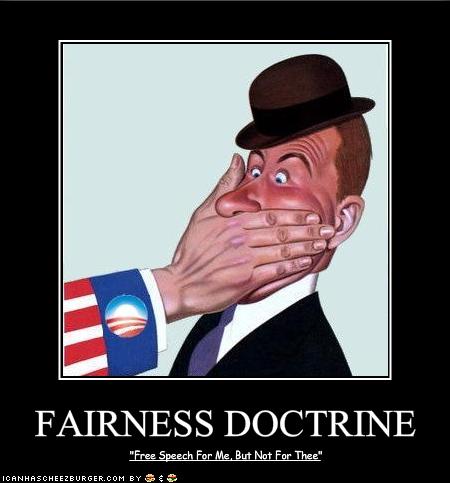
Which brings us to the latest crisis: the tragic shooting in Tucson, Arizona of Rep. Gabrielle Giffords and others. The instant analysis of the shooter's motivation was that it was a product of a harsh political environment. This has lead two Democratic representatives, Rep. Jim Clyburn (SC) and Rep. Bob Brady (PA), to propose reinstating the fairness doctrine. This FCC policy, first instated in 1949 and dropped in 1987, required broadcasters to present controversial issues of public importance in way that the FCC board finds to be honest and balanced. Supporters argue that a revived fairness doctrine would keep Rush Limbaugh, Glenn Beck, and Bill O'Reilly off the air, resulting in a more civil political discourse.

Hopefully, cooler heads will prevail and the fairness doctrine will remain dead. The history of this doctrine indicates that it leads to ersatz censorship, and that it is especially unfair to the left. The problem with the fairness doctrine is that FCC officials of the current administration determines what is "honest and balanced" coverage, and inevitably their definition of balance reflects the administrations' point of view. The temptation to abuse this doctrine is hard to resist; Arthur Larson, a Democratic official from the JFK / LBJ years, admitted to using the doctrine to suppress right wing broadcasters. Larson regretted this censorious use of the FCC, especially after Richard Nixon used the fairness doctrine to suppress his critics. Shows such as "The Smothers Brothers Comedy Hour" and the TV documentary "The Selling of the Pentagon" came under FCC scrutiny for their perceived left tilt. The liberal publications of that time (e.g. The Nation or Ramparts) decried the fairness doctrine on free speech grounds.

The democrats may control the FCC for now, but political fortunes can change on a dime. Remember back in 2004, when the Democratic party was given up for dead? In 2008, a mere 4 years later, political pundits declared that the Republicans would be a political minority for at least a generation. Then came the 2010 elections, and the tables turned once again. Who knows which side will control the FCC in 2013? Keep in mind that an FCC with the power to boot Rush Limbaugh, Glen Beck and Bill O'Reilly off the air also has the power to silence Keith Olbermann, Chris Matthews, and Rachel Maddow.

The fairness doctrine unfairly favors the status quo over the agents of change. Liberal support for this doctrine is therefore self defeating. We should not use this crisis to weaken our first amendment protections.

Saturday, June 5, 2010

The Nomi Song Will Set You Free

"I CELEBRATE myself, and sing myself,
And what I assume you shall assume,
For every atom belonging to me as good belongs to you."
- "Song of Myself" by Walt Whitman

"I'm young and I love to be young
I'm free and I love to be free
To live my life the way I want
To say and do whatever I please"
- "You Don't Own Me" by Leslie Gore
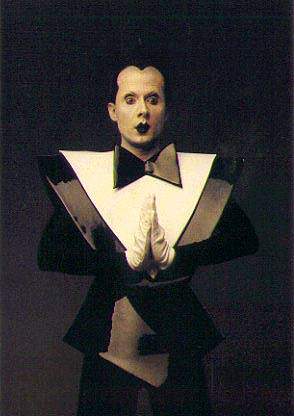
Klaus Nomi was one of the most talented Rock vocalists of all time, and certainly the one of most eccentric. His career was remarkably brief: he died on August 6, 1983, only two years after the release of his debut album. But the impact of his short tenure on the world stage nearly 27 years ago can still be seen in current culture and society.

Klaus was a leading light of the new wave movement in the late 1970's / early 1980's. This was an era when rock music was big business, and recorded music was the most profitable sector of the entertainment industry. But many artists felt that the obvious commercial success of the music industry was masking a serious problem: rock music was becoming standardized, dull, and formulaic. The rock genre needed new, fresh ideas in order to survive. In 1978, some young artists in New York devised a way to develop these new ideas by reviving an old idea: vaudeville. They staged a review called "New Wave Vaudeville" where performing artists of all stripes could try out their innovations before a live audience.

Enter Klaus Sperber, a West German counter tenor who had done some performing in Avant Garde theater. For the New Wave Vaudeville, he put together a rock act under the name Klaus Nomi. The act portrayed him as an visitor from another planet. He appeared on stage with a costume and make-up inspired by 1920's Dadaist theater, and with a hairstyle that actually emphasized that he was going bald. His set consisted of New Wave songs, classic rock songs, old standards like "Falling in Love Again", and his first love, opera. His stage persona was openly gay at a time when that was still controversial. Well, they said they were looking for something different, and Klaus Nomi definitely delivered. Nobody could mistake him for Eddie Money. As a vaudeville insider put it, "He was the wrong man, doing the wrong thing, at the wrong time". So naturally, he was the hit of the show.

His unusual background actually served him well in his role of rock singer. His opera training gave his voice phenomenal range and control. He also imparted a certain emotional intensity to every song he did, and his unique approach to his music provided us with a fresh look to even the most familiar of songs.

For example, Nomi did a cover of Leslie Gore's 1964 hit, "You Don't Own Me". Hailed as a feminist anthem, this song's lyrics are a girl's declaration of independence from a domineering boyfriend. Typically, when a man sings a song written for a woman, the gender references are swapped. Klaus sang the original lyrics, including the lyric "Don't say I can't go with other boys". In fact, when he gets to that line, he defiantly emphasized the word "boys". In short, he turned this feminist anthem into a gay pride anthem.

This song was seen as quite liberating by straight audiences as well as gay. This is in part because all of us, at some time or another, are burdened by social pressure. Nobody is a perfect match for societal norms, and hence everybody can sympathize with a square peg being hammered into a round hole. And that is what makes Nomi's cover of "You Don't Own Me" so joyous: in a world where this ultimate non-conformist can proclaim his freedom is a world where we can all be free.

After the New Wave Vaudeville, Klaus developed a devoted following in New York, and was very well received in Europe. He signed a contract with RCA. His debut album may be the only record that has both a song written by Chubby Checker and an aria written by Camille Saint-Saƫns. He seemed well on his way to making it big when he contracted AIDS. He became one of the first celebrities to die of the disease, passing away years before either Liberace or Rock Hudson.

In spite of his tragically early demise, Nomi continues to attract new generations of fans through some appropriately unconventional channels. The hipsters who produce the Adult Swim show "The Venture Brothers" included Klaus as a supporting character. More surprisingly, Nomi got a boost from conservative icon Rush Limbaugh. Rush uses Nomi's "You Don't Own Me" as one of his update themes, and this has spiked interest (and sales) among conservative republicans.

It may seem strange the same political movement that gave us the infamously anti-gay 1992 Family Values convention is now listening to the music of Klaus Nomi. I would argue that Klaus Nomi actually represents what the Republican party is supposed to be about far better than the 1992 convention did. After all, if the Republicans are serious about the principles of promoting limited government and individual liberty, what better spokesman could they have than Nomi?

The 2004 documentary of Klaus Nomi's life and career, "The Nomi Song" is now available online, and I heartily recommend it. If nothing else, catch the end of the film. The film makers have a very clever, almost magical and surprisingly upbeat way to wrap up his life story.