Showing posts with label Liberalism. Show all posts

Sunday, January 15, 2012

Speaking for the Left-Handed Majority

"But when you do your giving, do not let your left hand know what your right hand is doing"
- Matthew 6:3
"Some people are right-handed. Some people are left-handed. There are other people who are able to use both hands with equal ease. Such people are called Handbidextrous."
- Sally Brown in "Peanuts" by Charles M. Schulz
Of all the traits that evolution bestowed on humans, our dexterity is one of the most valuable. Yes, human intelligence and communication are quite essential to our species success, allowing us to create thoughts that can be shared widely and passed down through generations. But we would not be able to readily turn those thoughts into tools without the imposable thumb. Due to the value of our dexterity, one of the more important differences between humans is handedness. The majority of humans primarily use their right hands, and this is reflected throughout our culture and technology. The vast majority of languages are written from left to right. In most countries, traffic travels on the right side of the road, drivers are seated on left, and hence the gear shift is operated with the driver's right hand. Most desks, computer mice, scissors and watches are designed for the right handed. Most cameras are ridiculously right-handed.

The left-handed live in a world not designed for them, and yet many of them become quite accomplished:
  • Southpaws that have excelled in the arts include Michelangelo, Da Vinci, Toulouse Lautrec, and M.C. Escher;
  • The music world has benefited from left-handed artists such as Beethoven, Prokofiev, Mozart, Cole Porter, Judy Garland, David Bowie, and the two surviving Beatles;
  • Scientists Albert Einstein, Marie Curie, Albert Schweitzer, and Alan Turing were left handed; and
  • U.S. Presidents Harry Truman, Gerald Ford, Ronald Reagan, George H. W. Bush, Bill Clinton, and Barack Obama all won elections from a largely right-handed electorate.
So what percentage of the population is left-handed? This is a hard question, complicated by factors such as how to count the ambidextrous or those who have trained themselves to use the other hand. Depending on how you them, 10% to 20% of the population is left-handed. But in a more general sense, one could make the case that the vast majority of us are left handed. Each individual has some characteristics that differs from the majority, and these differences often have the downside of making it hard for said individual to "fit in". In this sense, virtually all of us are all left-handed.

The simple concept of the left-handed majority provides a pragmatic justification for tolerance. Every time you accommodate someone else's differences, you strengthen the social contract and hence advance acceptance of your own differences.

I am an unlikely spokesman for the left-handed majority. For one thing, I am right-handed. I am also a white heterosexual male and married with two offspring. On the other hand (pardon the expression), I am a member of a political minority (libertarians) and a religious minority (Unitarian-Universalism). This may seem like an odd combination. There is the common perception that libertarians are just conservatives who smoke marijuana. There is also the perception and that Unitarian-Universalist churches are the last refuge for Woodstock hippies. So how can an ersatz conservative join a granola church?

In part, I would answer this question by pointing out that these common perceptions are wrong. For the record, I am not a conservative, and the last time I smoked marijuana was back when disco music was not retro. But for the most part, I am a member of both these organizations due to some common themes. Libertarianism emphasizes freedom as the core political value of modern society. Unitarian-Universalists promote freedom of thought as a core religious value. Moreover, both groups celebrate our individuality, libertarians in the political sphere, Unitarian-Universalists in the religious realm. This is why I am a libertarian Unitarian-Universalist: I am doing it for the left-handed majority.

Update: check this Facebook page for more libertarian Unitarian-Universalists.

Sunday, July 24, 2011

Solving the Budget Crisis Through Theft


"If you steal from one author, it's plagiarism. If you steal from two, it's research."
- John Burke
"PlagiarizeLet no one else's work evade your eyes
Remember why the good Lord made your eyes
So don't shade your eyes
But plagiarize, plagiarize, plagiarize
Only be sure always to call it please 'research'"
- From "Lobachevsky" by Tom Lehrer.
The federal budget fight has been unusually acrimonious. On July 14, Obama walked out of the budget talks. On July 22, Boehner walked out of the budget talks. And throughout these talks, the American public has been walking out from both parties, and for good reason: neither party has been serious about tackling the debt crisis. Sure, both sides crow about how they have proposed drastic cuts, but these spending proposals are "cuts" only in a sense that is accepted no where else than Washington. What they mean by cuts is that they propose spending less than projected 2011 spending. Neither the "Cut, Cap, and Trade" proposal nor the president's most recent proposal would reduce 2011 spending to less than the previous year, even after adjusting last year's spending for inflation and population growth. The Republicans have been reluctant to really address the looming entitlement crisis. Congressional Democrats are even worse on this issue, threatening to block any entitlement program changes, while hypocritically complaining that the Republicans are too inflexible about taxes.

We need not worry the August 2 deadline, however. For starters, the default deadline is bogus anyways: the government need not default nor miss sending Social Security checks if the debt ceiling is not raised by August 2. But now that both sides have propped up this phony crisis, they will have to save face by coming up with some compromise before the "deadline". The bigger problem is that the compromise that the president and congress will likely fall far short of what is needed to reassure the rating services such as Standard and Poor's. They want to see creditable deficit reduction if U.S. government bonds are to retain their AAA ratings. If U.S. bonds are downgraded,
  1. Bond holders will be hurt; and
  2. The costs of U.S. borrowing will balloon.
So we may dodge the August 2 bullet, only to be hit with the S&P bond downgrade.

Dramatic action is required to prevent our bond rating dropping to AA. We need a deficit reduction plan, and fast. One effective approach would be to find a previous successful budget, and steal it. In short, we can solve our money problem by theft - not of money, but ideas.

I propose that the 2011 budget be based on the U.S. budget from 2000, one of the last budgets assembled before the 2 recent spendthrift administrations. This budget covered the basic government functions while spending less than the revenues collected. This budget was put together by a Democratic president working with a Republican congress - if they could do it, why can't we? When you adjust the 2000 budget for inflation and population growth, it comes out to $1,965,999 million. This would allow us to meet the S&P deficit reduction limits without taking the perilous action of raising taxes in a troubled economy. So one simple approach would be to adopt the 2000 budget, adjusted for inflation and population growth. This is the one sequel that we would all welcome.

Critics will immediately point out how the world has changed since 2000. We are now fighting 3 simultaneous wars, we have a slew of new agencies that have cropped up to fight the "War on Terror", a bunch of new Czars, not to mention ambitious new programs such as designing and building a whole new rail system. How could the 2000 budget cover these programs that did not exist 10 years ago? To this argument, I would reply that a large part of the reason we are in this mess is that we adopted expensive new programs without figuring out how to pay for them. We simply cannot afford all of them, so we need to prioritize. Given that we almost certainly cannot do both, should we engage in nation building in 3 middle east countries, or should we rebuild our own nation? Do we really need all these agencies that we were able to get along without for two centuries, and if so, could we pay for them by making cuts elsewhere in the 2000 prototype budget? If we really need the TSA, could we pay for it by eliminating the Import-Export bank or by cutting farm subsidies paid to millionaire farmers?

Real budget reform is possible. In fact, it is inevitable: the only real question is whether we fix the budget ourselves now or let our creditors decide how to fix it in the future. With the 200 budget austerity program, we can avoid default, avoid a credit downgrade, pay down the deficit, revive the economy, and then we can party like it's 1999.

Friday, January 28, 2011

The Defeat of Anti-Tea Party Paranoia

"Yea, though I walk through the valley of the shadow of death,
I will fear no evil: for thou art with me; thy rod and thy staff they comfort me"

- Psalms 23:4
"I'm not afraid (I'm not afraid) to take a stand (to take a stand)
Everybody (everybody) come take my hand (come take my hand)"
- "Not Afraid" by Eminem.
In reaction to a major man-made tragedy, a frightened public will frequently lash out at some group associated with the perpetrator, victimizing many innocent citizens in the process. When an anarchist assassinated president McKinley, there was a mass arrest of anarchists, including those who rejected violence in any form. After the bombing of Pearl Harbor, we had a similar round-up of Japanese Americans. McCarthyism is another example: anger over Soviet infiltration of the State Department led to a backlash over anyone connected with the Communists, even if that connection was tangential or decades old. One decade ago, American Muslims suffered from the rage over the 9/11 attacks.

As tragic as the shooting Rep. Gabriel Gifford shooting was, we should be grateful that there was not a major retaliation against some group loosely associated with suspect Jared Loughner. Certainly there was an attempt to tar the Tea Party movement with this crime, but fortunately that effort failed.

The effort started with Pima County Sheriff Clarence Dupnik's assessment that Loughner was motivated by the Tea Party and talk radio. This assessment came out before he had any time to investigate, and this lack of investigation showed. Jared Loughner has a significant web footprint, and a quick web search would have shown that Loughner was no Tea Partier. For example, on his YouTube account, he lists the Communist Manifesto as one of his favorite books. In one of his videos, he gleefully shows an American flag burning. Does this sound like the work of a Glenn Beck fan?

The worst example anti-Tea Party paranoia I've seen is a Palm Beach post article by Jose Lambiet where he seriously argues against praising the neurosurgeon who saved Rep. Gifford's life in the hours after her shooting. Why doesn't this doctor deserve our praise? Because, says Lambiet, his parents donated money to Tea Party candidates! This is absurd on multiple levels. First of all, he is holding the children responsible for the actions of their parents; one wonders if he would chastise JFK because his father was a bootlegger. But even if the good doctor had donated money to a Tea Party candidate, so what? The tea Party members running for office are obviously trying to change the system through non-violent means. They may well be wrong on many of their political views, but they are still within their rights to express those views.

Fortunately, quick action by some of our leaders nipped this anti-tea party parania in the bud. Credit for this should go first and foremost to President Barack Obama, who stated within days of the shooting that it would be unfair to blame the Tea Party for the actions of this madman. Rachel Maddow also spoke against using this incident to attack the Tea Party, in spite of her disagreements with them. Conservative activist Lee Doren praised Rachel Maddow for her stance on this matter.

What makes Obama and Maddow's comments so helpful is that both were known for their opposition to the Tea Party, so the public knew that these calls for restraint are based on principle. That may well have staved off a major round of anti-Tea Party paranoia.

I'm not sure if this had any effect on the debate, but you should check out long time progressive activist and frequent candidate Ralph Nader's comments on the Tea Party. Unlike most on the left, he is excited by the election of Tea Party members, because they will actually be allies of the progressives on some important issues. That's right, Lee Doren praised Rachel Maddow and Ralph Nader praised the Tea Party; we better check to see if Hell has any winter snow alerts.

Friday, December 31, 2010

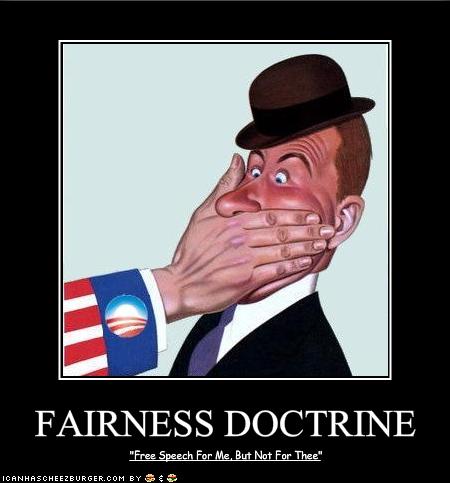
Why the Fairness Doctrine is Unfair to the Left


"Error of opinion may be tolerated where reason is left free to combat it."
- Thomas Jefferson, First Inaugural Address, 04 March 1801
"So let's leave it alone, 'cause we can't see eye to eye.
There ain't no good guys, there ain't no bad guys.
There's only you and me and we just disagree."
- From "We Just Disagree" by Billy Dean
The absolute worst laws are passed as a quick response to a crisis. In a heightened sense of urgency, lawmakers are willing to pass some extreme, simplistic solution whose faults become apparent only after the crisis has passed. The 9/11 attacks gave us the PATRIOT act and the TSA, and our civil liberties have suffered ever since. In 2008, the housing bust was addressed with two complex, obscenely expensive and hastily composed programs, the stimulus package and TARP. These programs did not prevent a severe economic downturn, and will be paid for by generations born long after this crisis has passes.

Which brings us to the latest crisis: the tragic shooting in Tucson, Arizona of Rep. Gabrielle Giffords and others. The instant analysis of the shooter's motivation was that it was a product of a harsh political environment. This has lead two Democratic representatives, Rep. Jim Clyburn (SC) and Rep. Bob Brady (PA), to propose reinstating the fairness doctrine. This FCC policy, first instated in 1949 and dropped in 1987, required broadcasters to present controversial issues of public importance in way that the FCC board finds to be honest and balanced. Supporters argue that a revived fairness doctrine would keep Rush Limbaugh, Glenn Beck, and Bill O'Reilly off the air, resulting in a more civil political discourse.

Hopefully, cooler heads will prevail and the fairness doctrine will remain dead. The history of this doctrine indicates that it leads to ersatz censorship, and that it is especially unfair to the left. The problem with the fairness doctrine is that FCC officials of the current administration determines what is "honest and balanced" coverage, and inevitably their definition of balance reflects the administrations' point of view. The temptation to abuse this doctrine is hard to resist; Arthur Larson, a Democratic official from the JFK / LBJ years, admitted to using the doctrine to suppress right wing broadcasters. Larson regretted this censorious use of the FCC, especially after Richard Nixon used the fairness doctrine to suppress his critics. Shows such as "The Smothers Brothers Comedy Hour" and the TV documentary "The Selling of the Pentagon" came under FCC scrutiny for their perceived left tilt. The liberal publications of that time (e.g. The Nation or Ramparts) decried the fairness doctrine on free speech grounds.

The democrats may control the FCC for now, but political fortunes can change on a dime. Remember back in 2004, when the Democratic party was given up for dead? In 2008, a mere 4 years later, political pundits declared that the Republicans would be a political minority for at least a generation. Then came the 2010 elections, and the tables turned once again. Who knows which side will control the FCC in 2013? Keep in mind that an FCC with the power to boot Rush Limbaugh, Glen Beck and Bill O'Reilly off the air also has the power to silence Keith Olbermann, Chris Matthews, and Rachel Maddow.

The fairness doctrine unfairly favors the status quo over the agents of change. Liberal support for this doctrine is therefore self defeating. We should not use this crisis to weaken our first amendment protections.

Sunday, November 14, 2010

Defending Keith Olbermann and Media Bias


"He would certainly rebuke you if you secretly showed partiality!"
- Job 13:10
"Think of what you're saying.
You can get it wrong and still you think that it's all right.
Think of what I'm saying,
We can work it out and get it straight, or say good night."

- from "We Can Work It Out" by Lennon and McCartney
MSNBC commentator Keith Olbermann was recently given a two day suspension for donating money to three democratic congressional campaigns. His NBC contract stipulates that he would not engage in such partisan activities with notifying the president of NBC news, and obtaining this president's approval. NBC requires this of all of their news staff in order to maintain their "journalistic impartiality".

I may be the worst person in the world to defend Olbermann. I find that like all too many cable news hosts, Olbermann frequently goes on sophomoric and tiresome rants. His attacks on Scott Brown, Michelle Malkin, and Bill O'Reilly were so over-the-top that they generated sympathy for his targets.

So why shouldn't NBC take punitive measures against Olbermann for violating his contract? Basically, because this contract requirement of impartiality, even in his off-air activities, makes no sense in the current media world, for at least three reasons.
  1. Olbermann does not does not host a show like the NBC nightly news where he is expected to be impartial. He hosts the video equivalent of a newspaper Op-Ed piece, where he is expected to give his opinion. How can he give his opinion and be impartial at the same time?
  2. It is questionable whether journalistic impartiality is a realistic goal. A study published in the Journal of Political Economy finds a slant in many 'balanced' news reports, due to the nature of the news business.
  3. When the national TV market was an oligopoly of three major networks, impartiality was a major concern. But with the explosion of news outlets on TV and the internet, we have a much better way to get both sides of a story. We can watch both a true liberal and a true conservative present their case. This is a vast improvement over having a single new anchor present his or her sincere point of view, and then for balance, present some alternative that he or she does not really believe in.
Keith Olbermann, Bill O'Reilly, Chris Matthews, and Glenn Beck may all say things that you disagree with. Certainly they have said things that I object to. But their contributions to the public dialog allows viewers to more clearly see issues from both sides of the left-right divide.

Speaking of the left-right divide, I heartily recommend the web site Blogging Heads TV. This site has videos of bloggers from differing sides debate each other over a web cam. You will be pleased to see how polite these bloggers are. They have mastered the art of disagreeing without being disagreeable. Another pleasant surprise is how often they come to agreement!

Before leaving, I should point out one point on which I emphatically agree with Keith Olbermann: his brave stance on Anwar al-Awlaki. And for those who would like to take a break from serious discussion, here is a lighter side of Olbermann.