Showing posts with label Popular Culture. Show all posts

Sunday, January 15, 2012

Speaking for the Left-Handed Majority

"But when you do your giving, do not let your left hand know what your right hand is doing"
- Matthew 6:3
"Some people are right-handed. Some people are left-handed. There are other people who are able to use both hands with equal ease. Such people are called Handbidextrous."
- Sally Brown in "Peanuts" by Charles M. Schulz
Of all the traits that evolution bestowed on humans, our dexterity is one of the most valuable. Yes, human intelligence and communication are quite essential to our species success, allowing us to create thoughts that can be shared widely and passed down through generations. But we would not be able to readily turn those thoughts into tools without the imposable thumb. Due to the value of our dexterity, one of the more important differences between humans is handedness. The majority of humans primarily use their right hands, and this is reflected throughout our culture and technology. The vast majority of languages are written from left to right. In most countries, traffic travels on the right side of the road, drivers are seated on left, and hence the gear shift is operated with the driver's right hand. Most desks, computer mice, scissors and watches are designed for the right handed. Most cameras are ridiculously right-handed.

The left-handed live in a world not designed for them, and yet many of them become quite accomplished:
  • Southpaws that have excelled in the arts include Michelangelo, Da Vinci, Toulouse Lautrec, and M.C. Escher;
  • The music world has benefited from left-handed artists such as Beethoven, Prokofiev, Mozart, Cole Porter, Judy Garland, David Bowie, and the two surviving Beatles;
  • Scientists Albert Einstein, Marie Curie, Albert Schweitzer, and Alan Turing were left handed; and
  • U.S. Presidents Harry Truman, Gerald Ford, Ronald Reagan, George H. W. Bush, Bill Clinton, and Barack Obama all won elections from a largely right-handed electorate.
So what percentage of the population is left-handed? This is a hard question, complicated by factors such as how to count the ambidextrous or those who have trained themselves to use the other hand. Depending on how you them, 10% to 20% of the population is left-handed. But in a more general sense, one could make the case that the vast majority of us are left handed. Each individual has some characteristics that differs from the majority, and these differences often have the downside of making it hard for said individual to "fit in". In this sense, virtually all of us are all left-handed.

The simple concept of the left-handed majority provides a pragmatic justification for tolerance. Every time you accommodate someone else's differences, you strengthen the social contract and hence advance acceptance of your own differences.

I am an unlikely spokesman for the left-handed majority. For one thing, I am right-handed. I am also a white heterosexual male and married with two offspring. On the other hand (pardon the expression), I am a member of a political minority (libertarians) and a religious minority (Unitarian-Universalism). This may seem like an odd combination. There is the common perception that libertarians are just conservatives who smoke marijuana. There is also the perception and that Unitarian-Universalist churches are the last refuge for Woodstock hippies. So how can an ersatz conservative join a granola church?

In part, I would answer this question by pointing out that these common perceptions are wrong. For the record, I am not a conservative, and the last time I smoked marijuana was back when disco music was not retro. But for the most part, I am a member of both these organizations due to some common themes. Libertarianism emphasizes freedom as the core political value of modern society. Unitarian-Universalists promote freedom of thought as a core religious value. Moreover, both groups celebrate our individuality, libertarians in the political sphere, Unitarian-Universalists in the religious realm. This is why I am a libertarian Unitarian-Universalist: I am doing it for the left-handed majority.

Update: check this Facebook page for more libertarian Unitarian-Universalists.

Saturday, March 5, 2011

Crossing the Board Game / Electronic Game Divide


"You have to learn the rules of the game. And then you have to play better than anyone else."
- Albert Einstein

"I think it's wrong that only one company makes the game Monopoly."

- Steven Wright

Video games have dominated the entertainment industry for the last few decades. The video games' older analog equivalent, the board game, has lost favor during this period. The number of board games sold last year was down 10% from the year before. In an attempt to reverse this decline, Hasbro will be releasing hybrid electronic / board games this fall. The first of these will be "Monopoly Live", followed by "Battleship Live".

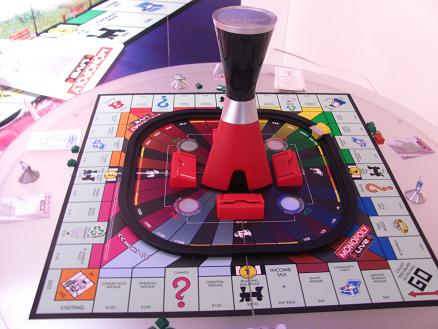
The Monopoly Live board has a battery powered computer control tower at its center that guides the players through the game. Hasbro contends that this tower's guidance allows a new player to start playing right away without having to first study the rules. The tower provides the following services:
  • It takes on the thankless job of banker;
  • It computes taxes and mortgage fees;
  • It rolls the dice;
  • It reads the Chance and Community Chest cards (with appropriate sound effects);
  • It manages the money electronically (players have ATM cards); and
  • It runs additional games events such as auctions, horse races and tax audits.
A demo of Monopoly Live can be seen here.

Needless to say, there are purists who object to this merger of traditional gaming and electronics, defending the superiority of analog-based fun. Now I don't dispute that traditional board games can be a lot of fun. When I was a child, video games had not been invented, so my family had fun with classic board games Operation, Mousetrap, Monopoly, Life, Clue, Checkers, Chinese Checkers, and Bridge-It, as well as sadly forgotten games such as Careers and Masterpiece.

But even with these fond memories for the traditional board games, I do not reject the Live board game concept. First of all, the golden age of board games is overrated. When studying the history of a cultural phenomena, such as shopping malls, comic books, network TV, and even retro video games, one often ends up romanticizing the past. One tends to remember the successes and forget the failures. As one who lived through that era, I can vouch that for every classic board game, there were dozens of dull, uncreative games that were not worth playing once. Most of the worst board games were TV or movie tie-in games (The same thing could be said about video games). Our neighbors had a "Dick Tracy" game that was so bad, the only way we managed to have fun with it was to figure out how we could make a good game out of the game board and pieces. Note: if anyone knows of a ROM hacker who has succeeded in making a good video game out of a bad one, please tell us about it in the comments.

These "Live" games will not be the first time that electronics have promoted a board game. Two classic strategy games, Chess and Go, are probably more popular now than any time in history, thanks to the fact that one can play virtually any opponent on the planet in real time, using an internet connection. Computers almost certainly saved the game Othello from extinction. Othello is a much older game than most people realize: it was originally published as Reversi in nineteenth century England. For many decades after its invention, Reversi was known only to a small but enthusiastic group of strategy game enthusiasts. It was not until a PC version of the game, under the name Othello, that the game finally attracted a large following. There are Othello leagues in many nations, as well as international competitions. I doubt if you would be able to buy an Othello set at most game stores if it were not for the PC game.

Computers have made our work life much easier. Since the invention of the Monopoly game, file cabinets have been replaced by databases, typewriters have been replaced with word processors, checks have been replaced with electronic transfers, and postage meters have been replaced with E-mail. All of these changes allow us to do a better job with less effort. But if electronics can make our work life easier, why not use this same technology to make our gaming easier, especially since gaming is supposed to be a recreational activity?

Finally, keep in mind that the point of a board game, or any game for that matter, is to have fun, and these Live games look like they'll be a blast. I'm hoping they are working on a "Clue Live" where the tower gives voice to a detective that sounds like Basil Rathbone.

Saturday, February 5, 2011

Coffin Nails and Death Chic

"God's finger touched him, and he slept."
- Alfred Tennyson
"So do the dead, through the lights
The surfin' dead, oooh make it tight
The livin' dead now baby lose their heads
Now baby, doin' the dead"
- From "Surfin' Dead" by the Cramps.
On June 22, the Tobacco Control Act will require that cigarette packages carry larger, more visible warning labels. The FDA has proposed a set of new warnings, which will cover at least 50% of the cigarette pack's display area and portray the negative consequences of smoking in a rather graphic, shocking fashion.

The new labels have been challenged as a violation of property or free speech rights. I object to these labels for an entirely different reason: they are likely to backfire and make cigarettes more appealing. Given that humanity's greatest fear, it may seem surprising that anything can be made more appealing by associating it with the dirt nap. But the "Death Chic" phenomenon is very real, so these warning labels could make cancer sticks hip again.

To illustrate this point, consider the health crisis second only to smoking: the obesity epidemic. Certainly the owner of a grill would avoid any warnings that eating fatty foods like hamburgers could lead to heart ailments, right? Well, you'd think so, but think again. The Heart Attack Grill in Chandler Arizona makes it quite clear that its food is bad for you. It's not just the grill's name or its slogan ("Taste Worth Dying For"): the waitresses are dressed as nurses. The burgers come in three sizes: single bypass, double bypass, and quadruple bypass. Your order is identified by a hospital tag. And in spite of all these warnings, the grill has a large following. Fans from across the globe post to their Facebook page asking when a Heart Attack Grill will open in their country.

And what about that other addictive vice, alcohol? In the 90's, one of hottest vodka brands was "Black Death". Here is a bottle of Black Death in its promotional packaging; as you can see, the distillers have all the chutzpah of the Heart Attack Grill. Eventually, this product was forced off the market, but not by low sales. The regulators at the Bureau of Alcohol, Tobacco and Firearms were horrified by the product, and were even more horrified when the product was a hit. Unlike in the U.K., U.S. regulators never allowed the sale of "Black Death" vodka in its special dark glass, skull-shaped bottle.

In the popular arts, death sells everything from Heavy Metal rock, horror films, and even a cartoon series. So why are so many people attracted to embodiments of our greatest fear? Human behavior is rather complex, but there may be some simple explanations for death chic. Because death is so scary, facing death is a way of coming across as being totally bad-ass. Also, some of our current public heath campaigns have become so shrill that they come across as nagging. To many people, the campaign against obesity has definitely crossed into nagging territory, hence the popularity of the Heart Attack Cafe. It is a way of raising a pudgy middle finger to all the health experts who pester us about what we should eat.

So how do we avoid giving cigarettes an aura of death chic? First of all, don't use king size warning labels. The 50% size labels are the visual equivalent of shouting, and experience on internet forums indicates that shouting is frequently less effective than understatement. And forget the melodramatic "this product will kill you and every one you love for seven generations" messages. The warnings that are more likely to scare off potential smokers would basically say that buying this product makes you a real schmuck. Here are my recommended warnings:
  • Bought some cigarettes? Good luck finding a place where you can smoke them.
  • Warning: This product will force you to periodically leave your friends to smoke alone in the rain.
  • Warning: If you use this product, every cent you spent on cologne and teeth whiteners will be wasted.
  • Warning: If you buy this, you'll be paying way too much tax.
  • Warning: Being seen with this product will get you labeled as a creepy loser.
And finally, if we could get away with it, the most effective warning label of all would be:
  • Warning: The surgeon general has determined that smoking dramatically decreases your chances of getting laid.
After all, any Madison Avenue executive will tell you that sex sells, even more than death.

Sunday, August 29, 2010

The Dismal Science, Gangsta Rap Version


"We are all Keynesians now."
- President Richard M. Nixon

"We’ve been going back and forth for a century
[Keynes] I want to steer markets,
[Hayek] I want them set free
There’s a boom and bust cycle and good reason to fear it
[Hayek] Blame low interest rates.
[Keynes] No… it’s the animal spirits"
- From "Fear the Boom and Bust" by John Papola & Russ Roberts
Our anemic economy has dominated the news of late, and will almost certainly be the central issue in the November elections. In spite of record stimulus spending, we still have nearly 10% unemployment and sagging housing sales. The debate over this crisis centers around two economists of the previous century, John Maynard Keynes (1883-1946) and Frederic A. Hayek (1899-1992).
  • In the book "The General Theory of Employment, Interest and Money", Keynes argues that in times of economic downturns, government spending must increase in order to boost aggregate demand.
  • Hayek, Nobel prize winner and author of the 1944 best seller "The Road to Serfdom", argued that excessive government spending could make things even worse by creating perverse incentives and blunting price signals.
Voters would greatly benefit from an understanding of these two great economists. Elites often lament that far too few voters have an appetite for scholarly treatises on topics such as economics, preferring instead to indulge in pop culture. How could Hayek and Keynes possibly compete with "Dancing with the Stars"?

What about combining economics with pop culture? This unlikely idea occurred to fledgling television producer / directors John Papola and Russ Roberts. Concerned about the current downturn, Papola felt that it was important to get these ideas to a wider audience. Papola and Roberts considered several popular culture renditions of the ideas of Keynes and Hayek, finally settling on a rap video. The resulting video, "Fear the Boom and Bust", has been views 1.3 million times on YouTube. It has been translated into Spanish, French, Japanese and Chinese. Economics professors across the globe have shown this video to their classes. The producers have received kudos from both noted Keynes biographer
Robert Skidelsky and rapper Kei$ha.

See http://www.econstories.tv for more about this remarkable video that demonstrates that popular culture can actually promote learning.