Showing posts with label Capitalism. Show all posts

Sunday, September 9, 2012

Will America Become Detroit, Part 5: Debt Will End Corporate Welfare as We Know It

That's how we're gonna keep 'em down on the farm
"The statesman who should attempt to direct private people in what manner they ought to employ their capitals, would not only load himself with a most unnecessary attention, but assume an authority which could safely be trusted, not only to no single person, but to no council or senate whatever, and which would nowhere be so dangerous as in the hands of a man who had folly and presumption enough to fancy himself fit to exercise it."
- "The Wealth of Nations" by Adam Smith
"Government is the great fiction through which everybody endeavors to live at the expense of everybody else."
- Frederic Bastiat
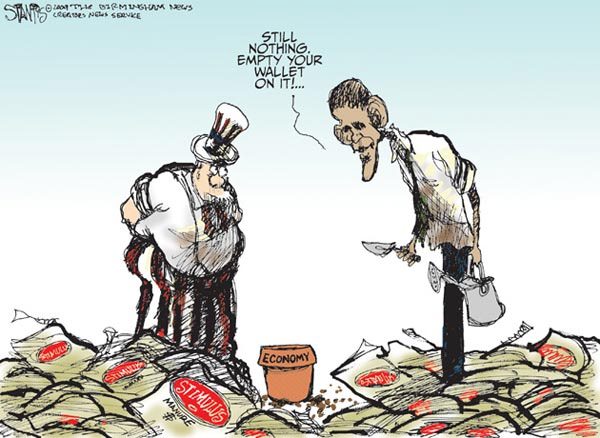
The coining of a new word, or the re-introduction of a long dormant word, can often advance our understanding of important issues. A prime example is the word "corporatism" that pervades much of current political discourse to derisively describe economic policies designed around the needs of the present leading corporations. A prime example of corporatism is the bank bailouts of 2008, a bi-partisan policy that eventually were condemned by both the Tea Party and the Occupy Wall Street movements.

Real Capitalism Versus Crony Capitalism

Before this word gained popularity, many ascribed the attributes of corporatism to free market economics. This is rather ironic: the eighteenth century term for the corporatist ideology is mercantilism. Adam Smith, the father of modern economics, strongly refutes the tenants of mercantilism in his opus "An Inquiry into the Nature and Causes of the Wealth of Nations". In a true free market, the government does not show favoritism to the elite corporations. It is the consumer, not the state, that picks winners and losers in a free market economy. Corporatism is not only a highly unfair public policy, it is also poor economic policy. A company favored by corporatism is shielded from competitive pressures, and hence does not make the improvements that the unprotected companies would. Competition has given us the iPhone and Android cell phone technology. Corporatism has given Bangladesh a typewriter industry that survived until this decade.

Corporate Welfare: Supported by Many, Liked by No One

The most outrageous form of corporatism is corporate welfare, where the government actually subsidizes particular businesses. This practice is denounced across the political spectrum, which raises the question as to why it is so prevalent. The problem is that welfare is in the eye of the beholder. Voters often fail to see that aid to the industries that they work in as welfare, and will cast their votes to save that aid.

A prime example of this is our agriculture subsidies, a program that protects farmers' income with price supports that keep domestic food prices artificially high. Our agricultural policy keeps U.S. sugar prices at twice the world level. As a result, candies such as Life-Savers are no longer made in this country. The high sugar prices have also forced American soft drink manufacturers to use high fructose corn syrup in place of sugar. The politically connected farm lobby have also pushed ethanol usage, a real boon for corn farmers but an expensive burden both at the pump and at the grocery store. Ethanol is not even good for the environment; producing ethanol uses more fossil fuel than it replaces, which is why Al Gore no longer endorses it. The only advantage to the ethanol program is that it makes farming more profitable.

Why, in a democracy, do these programs that benefit a few at the expense of the many stay alive for so long? The problem is that we do not directly vote on issues like this; instead, we vote for representatives, who will be voting on many issues. When choosing a representative, voters tend to focus on the few issues that are most important to them. Although most voters believe (correctly) that they would benefit from eliminating corporate welfare, very few voters have that as their top issue. The top issue for most voters is aid for their own industry, i.e. what is clearly corporate welfare to anyone outside that industry. This is why corporate welfare constantly wins elections, in spite of its unpopularity.

Putting Corporate Welfare on the Table

In the battle over corporate welfare, the debt crisis could be a game changer. The federal spend approximately $100 billion per year on corporate welfare, which is more than what it spent on welfare for individuals. When the nation's debt is called, these expenditures has to be on the table. We simply cannot afford to maintain all of these corporate welfare programs. At that point, how can one make a politically viable pitch for saving any of these programs?

In short, the debt crisis will force a type of welfare reform for corporations, similar to the Personal Responsibility and Work Opportunity Act of 1996. Proponents for the 1996 welfare reform act argued that recipients are better served by being transitioned to some form of self reliance when possible. Soon, it will be widely recognized that this same principle applies to corporations: they should not be dependent on the government.

Sunday, September 18, 2011

The New Industrial State is Not Too Big to Fail


"There is no remembrance of former things; neither shall there be any remembrance of things that are to come with those that shall come after."
- Ecclesiastes 1:12
"Your castles may tumble (that's fate after all)
Life's really funny that way
No use to grumble, smile as they fall
Weren't you king for a day?"

- From "Wrap Your Troubles in Dreams" (1931), lyrics by Ted Koehler and Billy Moll

The news coverage of Steve Jobs' retirement from Apple predictably discussed his greatest successes: the iMac, the iPod, the iPhone, and the iPad. But many articles about this event also covered his failed projects: the Apple III, the Apple Lisa, and the NeXT workstation. This is commendable, for Jobs' clunkers are an important part of the story. We learn more from failure than we do from success. If Jobs did not learn from his blunders, he might never have come up with the iPhone.

There is a failed project that can teach us a lot about our current financial crisis: the book "The New Industrial State" by famed economist John Kenneth Galbraith, based on a lecture series broadcast by the BBC. The main theme of this book is that the large corporations are no longer subject to market forces. Galbraith contends that the big industry leaders can use a combination of leverage, advertizing, and consolidation to squash any competitor that threatens them. The book focuses on several large corporations that J.K. Galbraith contends will always dominate their industry.

So what's the problem with this book? Well, it was first published in 1967, and as fans of Mad Men can tell you, the markets have changed quite a lot since the 1960's. Back then, General Motors made more than half of the cars sold in the U.S., as well as a significant share of some foreign markets. So naturally "The New Industrial State" assures us that GM is one of the companies that need not worry about competition. When it comes to computers, whether we are talking about hardware or software, the book asserts that the one company that matters will always be IBM. And what about retail? Remember, 1967 is before Walmart or even Kmart made it big, so the book's examples of the forever dominant retailers are Sears (currently on the ropes) and Montgomery Ward (went bankrupt in 2000, although recently revived as an online store). These 1960's corporate giants lost their market dominance to new companies whose innovations won over the customers. The history of the last few decades provides the definitive rebuttal to "The New Industrial State": even the largest corporations must remain competitive to stay alive.

The basic premise of "The New Industrial State" is widely believed today. If only I had a dime for each prediction that the internet will no longer be a venue of free speech because soon one company will take over the internet. Funny thing is, the company that is predicted to take over the internet keeps changing: Netscape, Microsoft, AOL, Google, and Facebook have all been projected to be our future on-line overlord. In 5 years, there will probably be some company not in this list that will be viewed as the future emperor of the internet.

Some very important insights in our current economy can be learned from the failure of "The New Industrial State".
  • There is no corporation that is "Too Big to Fail". When a corporation falters, there are plenty of other companies that will pick up the slack. In the 1970's, A&P went from the largest grocery chain in the country to a chain that operated in a handful of east coast states. The closures of all those A&P stores did not cause mass starvation, for these closures were matched by openings of other grocery stores.
  • The 2008 bailouts of failed large corporations were therefore unnecessary and counterproductive. At a time when the federal government could ill afford it, taxpayer dollars were wasted to reward poor corporate decisions at the expense of those companies that served their customers better.
  • The government should not be in the business of picking market leaders. Keep in mind that John Kenneth Galbraith was an award winning economist who advised presidents FDR and JFK. If Galbraith could not predict which companies would prevail, what chance do we have that our current experts can safely invest our tax dollars in future winning companies? This is the sort of hubris that lead to the Solyndra debacle.
Like the Apple III, "The New Industrial State" is a flawed work, but we can learn a lot from its errors. One wonders if the president's economic team understand where Galbraith went wrong, so that they can avoid repeating his mistakes.

Sunday, February 20, 2011

Texas School Children: Give Choice a Chance

"Liberty, according to my metaphysics is a self-determining power in an intellectual agent. It implies thought and choice and power."
- John Adams
"Teach, your children well
Their father's hell
Did slowly go by
And feed them on your dreams
The one they pick's
The one you'll know by."
- From "Teach Your Children" by Graham Nash.
In this third and final post on the Texas school districts that discipline students using the legal system, I would like to focus on one incident from the Texas Appleseed report that exposes the root of many of the problems with American public education:
"A 17-year-old girl with autism became frustrated [in class]. The teacher who best understood how to manage her behaviors was off work that day. The substitute did not know how to respond and accidentally escalated the situation by talking loudly and getting close to the student. The young lady left the classroom without permission, cursed and then sat in the hallway rocking back and forth to calm herself. When the assistant principal heard what happened, he asked a police officer to write a citation for Disruption of Class. The young lady’s single, low-income mother came to the school to talk to the vice principal, explaining that her daughter did not have full control of her behavior and was not able to understand the citation. She also explained she could not pay for citations. The vice principal told the mom that if she did not want her daughter to get more citations, she should withdraw the daughter from school because she was old enough to drop out."
As the father of an autistic son, I find this incident especially appalling. One's first impression is to blame the vice principle for this injustice, but the problem goes beyond this one employee. True, the vice principle did not act in the student's best interest, but he did act in the school's best interest. But why does the school's best interest differ from those of the students? This perverse incentive system is a result of the lack of choice on the part of the student.

In most circumstances, most American public school students have no choice as to which school to attend. Moreover, school financing is generally based on the number of school aged children in the district, not on how many students actually attend the school. The school's budget is not negatively affected by their students switching to private education or home schooling.

We can empower student's families with a change to the way we finance public schools. Instead of allocating education money to the schools, we could these funds to the child, with additional public funds provided for students with special educational needs. The family would then choose which public school their child would attend, and then that school would receive the funding for educating that child. School that attracts more students would receive more financing, schools that loses students would be forced to tighten their belts. Under such a system, could you imagine a vice principle recommending that a student drop out?

Would the Texas system of legal fines for school offenses such a cursing, talking back and skipping classes be adapted in a school choice system? As we have seen, this system has been particularly harsh with racial minorities and the handicapped. These students would undoubtedly exercise their choice for a school that takes a more humane approach to discipline. No family would be forced to endure the Texas ticketing system.

School choice is not just an academic theory. It is practiced in Belgium, France, Sweden, Chile, Ontario, and New Zealand. The countries where choice has been tried get better student test results than American public schools, and get those results at lower cost. This is the unsurprising consequence of families choosing the schools that works best for their children.

When we buy a product like breakfast cereal or a laptop, we insist on having a choice between several providers in order to get the best product. And yet we settle for no choice in a much more important matter: the education of our next generation. Our children deserve better; they deserve a choice.

One final note: my autistic son Jonathan has his own blog, as well as his own YouTube account. He may be constrained by his condition, but that never stops Jonathan from making the most of what he can accomplish. This is what I admire most about him.

Tuesday, October 19, 2010

Government Greed

"Be on your guard against all kinds of greed; for one’s life does not consist in the abundance of possessions."
- Luke 12:15"

Money, so they say
Is the root of all evil today
But if you ask for a rise
It's no surprise
That they're
giving none away"
- From "Money" by Roger Waters
In many an economic debate, you will find one participant who feels that all our troubles can be boiled down to one word: greed. You've heard this argument before: greed is what drives the profit motive, the basis of free market economies, and that this dependence on one of the seven deadly sins accounts for all our society's ills, including oil spills, stock market crashes, and lousy "Star Wars" sequels. If I had a dime for every time someone given this one word diagnosis, I'd be, well, a successful capitalist.

This one word critique of free market economics is quite emotionally satisfying, but it does not hold up to scrutiny for a number of reasons. The world economic environment is extremely complex, and one word diagnoses generally do not apply to systems more complicated than a food processor. The greed critique of the private sector also seems to make the assumption that, in the absence of profits, people behave in a less greedy fashion. But a number of recent news stories confirm that the public sector succumbs to greed at least as often as the private sector.

For example, many cities and towns use special cameras to ticket drivers who run red lights. These are there for our safety, or so we are told. But multiple studies have recently shown that red light cameras actually increases accidents. When drivers spot the cameras, they frequently slam on the brakes, and this causes more accidents than are prevented by the cameras. In fact, a Dutch city has discovered that they can decrease accidents by a re-design of their roads that does not use traffic lights at all. So how many cities have dropped the red light cameras in light of these studies? Whenever this question is posed to city officials, it is amazing how quickly the topic is changed from safety to how could we possibly replace the lost ticket revenue. So are these cameras used because of safety, or because of greed?

Consider the recent pay scandal in Bell, California, a small, lower middle working class suburb of Los Angeles. The median family income in Bell is only $30,504, but the city residents pay some of the highest property tax rates in the country. When city officials insisted that these taxes needed to be raised even further to keep the city solvent, investigative reporters looked from the L. A. Times looked into city finances. They found that Bell was dramatically overpaying its officials. The Bell police chief earned 33% more than the police chief of Los Angeles. The city manager's base salary was $800,000, almost twice as much as what we pay the president of the United States, and bonuses and other benefits raised his total compensation for last year to $1.5 million dollars. To the poor, over-taxed families of Bell, this looks like greed.

Another case to ponder: in 1992, Massachusetts passed a ballot initiative to increase tobacco taxes, and to use the additional revenue for tobacco prevention programs. Starting in 1993, the state had created an effective anti-smoking ad campaign. The most popular of these ads featured the saga of Pam Laffin, a young woman who was dying of emphysema. The ads traced her various diagnoses, her vain attempt to get a lung transplant, and finally her death that left her two young daughters without a mother. The ads had quite an impact: the number of smokers in the state dropped off faster than the national average. And yet, this successful ad campaign dropped less than a decade later.

Now why did the state drop a program that was actually helping smokers quit? Too expensive, of course. Forget the promise to voters that the tobacco tax money would go to tobacco prevention, the legislators decided that they had better uses for the money. Don't worry that the tobacco tax is highly regressive, for smokers are a politically unpopular group. When tobacco companies benefit from the unhealthful addiction of smokers, we call that greed. So when the state over-taxes these same smokers, why isn't that greed?

These and other examples of government avarice show that the public sector effort to eliminate greed is about as successful as the Puritan effort to eliminate lust. It's not clear if , greed is an integral part of human nature. It is not an issue of whether "Greed is good", the main point is that "Greed is". One virtue of free markets is that they harness greed to some positive ends. For all the moral posturing, It was greed that propelled the tremendous improvements in our PC's (Moore's Law), in our cars, and in our home entertainment (from LP's to CD's to MP3's, from VHS to DVD to Blue Ray).

So the next time you hear someone sanctimoniously boiling down a complex issue to one word ("Greed"), feel free to accuse him of one of the other deadly sins: sloth.

Sunday, January 24, 2010

Charles Darwin Meets Adam Smith

"Orgel's Second Rule: Evolution is cleverer than you are."
- Francis Crick

"Now there's no more oak oppression,
For they passed a noble law,
And the trees are all kept equal
By hatchet, axe, and saw."
- From "Trees" by Neil Peart
Great ideas in one field of study are often variants of great ideas in another field. Consider the theory of evolution as developed Charles Darwin, the father of modern biology. According to the theory of evolution, each new generation of a species will include genetic variations. The vast majority of these variation will not help the organism to survive, and hence will quickly disappear. The rare variation that helps the organism survive, however, will be passed onto the next generation and will improve the species. The rich, vibrant ecological system we have today is the bi-product of the myriad of these variants that have occurred in Earth's history.

The process of evolution can seem wasteful and cruel: not only do most variants fail, but often once viable species become extinct due to competition from new species. But the destruction of less fit species is a vital part of the process, and the payoff of this process is huge.

The theory of Evolution has a striking resemblance to the free market concept as advocated by Adam Smith, the father of modern economics. In a free market economy, one is permitted to start a new business to provide a good or service. As with most biological variants, most new businesses fail. But the business that finds a better way to satisfy market needs will have a competitive advantage that will allow it to survive. As with evolution, a free market economy can seem cruel and wasteful, as many new businesses and even old established businesses go under. But this destruction is an essential part of the process of improving the economy. The fall of less fit companies is required to allow the next innovations to thrive.

The recently proposed "Financial Crisis Responsibility Fee" shows how poorly the work of Adam Smith (and evolution) is understood in Washington these days. The idea is being sold as a way for the taxpayers to get back the money they lent to the bankers for the recent bailout. The problem with this fee, however, is banks that have already repaid their loans with interest, and even banks that did not take any federal funds, will be required to pay this fee. In effect, the banks that managed the recent financial tsunami properly will be called on to cover the expenses caused by less well run banks. None of this "survival of the fittest" jazz here; D.C. has decided that all banks should be saved, whether they are fit or not.

To understand what is wrong with this proposal, consider what would have happened if the proponents of this proposal had been in charge of fixing the Earth's environmental crisis of 65 million B.C.E.
"Let me be clear: the major species of this planet, the Tyrannosaurus and Triceratops are too big to fail without causing the ecology to go into major collapse. There are those who say that we need to choose between saving these dinosaurs and allowing the new mammals to flourish. This is a false choice: the Earth can support both, as long as the new mammals follow sensible restrictions. I tell these new mammal species that there is a time for multiplication, but now is not that time. "
I'm glad this approach was not taken in the late Cretaceous period: the dinosaurs would still have gone extinct, and the world would now be poorer for this futile attempt to put off the inevitable. The proposed bank fee was a bad idea 65 million years ago, and it still is a bad idea today.