Showing posts with label Bailout. Show all posts

Sunday, September 9, 2012

Will America Become Detroit, Part 5: Debt Will End Corporate Welfare as We Know It

That's how we're gonna keep 'em down on the farm
"The statesman who should attempt to direct private people in what manner they ought to employ their capitals, would not only load himself with a most unnecessary attention, but assume an authority which could safely be trusted, not only to no single person, but to no council or senate whatever, and which would nowhere be so dangerous as in the hands of a man who had folly and presumption enough to fancy himself fit to exercise it."
- "The Wealth of Nations" by Adam Smith
"Government is the great fiction through which everybody endeavors to live at the expense of everybody else."
- Frederic Bastiat
The coining of a new word, or the re-introduction of a long dormant word, can often advance our understanding of important issues. A prime example is the word "corporatism" that pervades much of current political discourse to derisively describe economic policies designed around the needs of the present leading corporations. A prime example of corporatism is the bank bailouts of 2008, a bi-partisan policy that eventually were condemned by both the Tea Party and the Occupy Wall Street movements.

Real Capitalism Versus Crony Capitalism

Before this word gained popularity, many ascribed the attributes of corporatism to free market economics. This is rather ironic: the eighteenth century term for the corporatist ideology is mercantilism. Adam Smith, the father of modern economics, strongly refutes the tenants of mercantilism in his opus "An Inquiry into the Nature and Causes of the Wealth of Nations". In a true free market, the government does not show favoritism to the elite corporations. It is the consumer, not the state, that picks winners and losers in a free market economy. Corporatism is not only a highly unfair public policy, it is also poor economic policy. A company favored by corporatism is shielded from competitive pressures, and hence does not make the improvements that the unprotected companies would. Competition has given us the iPhone and Android cell phone technology. Corporatism has given Bangladesh a typewriter industry that survived until this decade.

Corporate Welfare: Supported by Many, Liked by No One

The most outrageous form of corporatism is corporate welfare, where the government actually subsidizes particular businesses. This practice is denounced across the political spectrum, which raises the question as to why it is so prevalent. The problem is that welfare is in the eye of the beholder. Voters often fail to see that aid to the industries that they work in as welfare, and will cast their votes to save that aid.

A prime example of this is our agriculture subsidies, a program that protects farmers' income with price supports that keep domestic food prices artificially high. Our agricultural policy keeps U.S. sugar prices at twice the world level. As a result, candies such as Life-Savers are no longer made in this country. The high sugar prices have also forced American soft drink manufacturers to use high fructose corn syrup in place of sugar. The politically connected farm lobby have also pushed ethanol usage, a real boon for corn farmers but an expensive burden both at the pump and at the grocery store. Ethanol is not even good for the environment; producing ethanol uses more fossil fuel than it replaces, which is why Al Gore no longer endorses it. The only advantage to the ethanol program is that it makes farming more profitable.

Why, in a democracy, do these programs that benefit a few at the expense of the many stay alive for so long? The problem is that we do not directly vote on issues like this; instead, we vote for representatives, who will be voting on many issues. When choosing a representative, voters tend to focus on the few issues that are most important to them. Although most voters believe (correctly) that they would benefit from eliminating corporate welfare, very few voters have that as their top issue. The top issue for most voters is aid for their own industry, i.e. what is clearly corporate welfare to anyone outside that industry. This is why corporate welfare constantly wins elections, in spite of its unpopularity.

Putting Corporate Welfare on the Table

In the battle over corporate welfare, the debt crisis could be a game changer. The federal spend approximately $100 billion per year on corporate welfare, which is more than what it spent on welfare for individuals. When the nation's debt is called, these expenditures has to be on the table. We simply cannot afford to maintain all of these corporate welfare programs. At that point, how can one make a politically viable pitch for saving any of these programs?

In short, the debt crisis will force a type of welfare reform for corporations, similar to the Personal Responsibility and Work Opportunity Act of 1996. Proponents for the 1996 welfare reform act argued that recipients are better served by being transitioned to some form of self reliance when possible. Soon, it will be widely recognized that this same principle applies to corporations: they should not be dependent on the government.

Sunday, September 18, 2011

The New Industrial State is Not Too Big to Fail


"There is no remembrance of former things; neither shall there be any remembrance of things that are to come with those that shall come after."
- Ecclesiastes 1:12
"Your castles may tumble (that's fate after all)
Life's really funny that way
No use to grumble, smile as they fall
Weren't you king for a day?"

- From "Wrap Your Troubles in Dreams" (1931), lyrics by Ted Koehler and Billy Moll

The news coverage of Steve Jobs' retirement from Apple predictably discussed his greatest successes: the iMac, the iPod, the iPhone, and the iPad. But many articles about this event also covered his failed projects: the Apple III, the Apple Lisa, and the NeXT workstation. This is commendable, for Jobs' clunkers are an important part of the story. We learn more from failure than we do from success. If Jobs did not learn from his blunders, he might never have come up with the iPhone.

There is a failed project that can teach us a lot about our current financial crisis: the book "The New Industrial State" by famed economist John Kenneth Galbraith, based on a lecture series broadcast by the BBC. The main theme of this book is that the large corporations are no longer subject to market forces. Galbraith contends that the big industry leaders can use a combination of leverage, advertizing, and consolidation to squash any competitor that threatens them. The book focuses on several large corporations that J.K. Galbraith contends will always dominate their industry.

So what's the problem with this book? Well, it was first published in 1967, and as fans of Mad Men can tell you, the markets have changed quite a lot since the 1960's. Back then, General Motors made more than half of the cars sold in the U.S., as well as a significant share of some foreign markets. So naturally "The New Industrial State" assures us that GM is one of the companies that need not worry about competition. When it comes to computers, whether we are talking about hardware or software, the book asserts that the one company that matters will always be IBM. And what about retail? Remember, 1967 is before Walmart or even Kmart made it big, so the book's examples of the forever dominant retailers are Sears (currently on the ropes) and Montgomery Ward (went bankrupt in 2000, although recently revived as an online store). These 1960's corporate giants lost their market dominance to new companies whose innovations won over the customers. The history of the last few decades provides the definitive rebuttal to "The New Industrial State": even the largest corporations must remain competitive to stay alive.

The basic premise of "The New Industrial State" is widely believed today. If only I had a dime for each prediction that the internet will no longer be a venue of free speech because soon one company will take over the internet. Funny thing is, the company that is predicted to take over the internet keeps changing: Netscape, Microsoft, AOL, Google, and Facebook have all been projected to be our future on-line overlord. In 5 years, there will probably be some company not in this list that will be viewed as the future emperor of the internet.

Some very important insights in our current economy can be learned from the failure of "The New Industrial State".
  • There is no corporation that is "Too Big to Fail". When a corporation falters, there are plenty of other companies that will pick up the slack. In the 1970's, A&P went from the largest grocery chain in the country to a chain that operated in a handful of east coast states. The closures of all those A&P stores did not cause mass starvation, for these closures were matched by openings of other grocery stores.
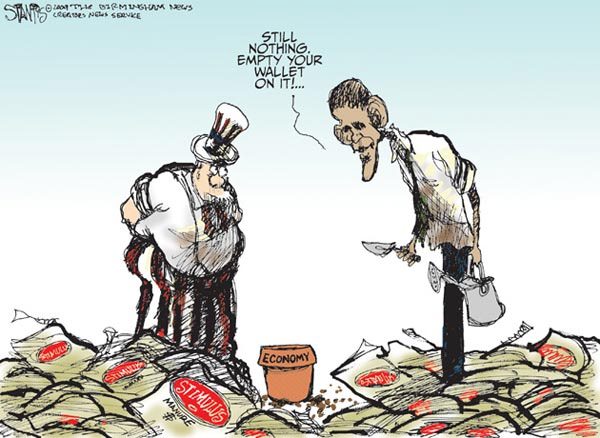
  • The 2008 bailouts of failed large corporations were therefore unnecessary and counterproductive. At a time when the federal government could ill afford it, taxpayer dollars were wasted to reward poor corporate decisions at the expense of those companies that served their customers better.
  • The government should not be in the business of picking market leaders. Keep in mind that John Kenneth Galbraith was an award winning economist who advised presidents FDR and JFK. If Galbraith could not predict which companies would prevail, what chance do we have that our current experts can safely invest our tax dollars in future winning companies? This is the sort of hubris that lead to the Solyndra debacle.
Like the Apple III, "The New Industrial State" is a flawed work, but we can learn a lot from its errors. One wonders if the president's economic team understand where Galbraith went wrong, so that they can avoid repeating his mistakes.

Sunday, January 24, 2010

Charles Darwin Meets Adam Smith

"Orgel's Second Rule: Evolution is cleverer than you are."
- Francis Crick

"Now there's no more oak oppression,
For they passed a noble law,
And the trees are all kept equal
By hatchet, axe, and saw."
- From "Trees" by Neil Peart
Great ideas in one field of study are often variants of great ideas in another field. Consider the theory of evolution as developed Charles Darwin, the father of modern biology. According to the theory of evolution, each new generation of a species will include genetic variations. The vast majority of these variation will not help the organism to survive, and hence will quickly disappear. The rare variation that helps the organism survive, however, will be passed onto the next generation and will improve the species. The rich, vibrant ecological system we have today is the bi-product of the myriad of these variants that have occurred in Earth's history.

The process of evolution can seem wasteful and cruel: not only do most variants fail, but often once viable species become extinct due to competition from new species. But the destruction of less fit species is a vital part of the process, and the payoff of this process is huge.

The theory of Evolution has a striking resemblance to the free market concept as advocated by Adam Smith, the father of modern economics. In a free market economy, one is permitted to start a new business to provide a good or service. As with most biological variants, most new businesses fail. But the business that finds a better way to satisfy market needs will have a competitive advantage that will allow it to survive. As with evolution, a free market economy can seem cruel and wasteful, as many new businesses and even old established businesses go under. But this destruction is an essential part of the process of improving the economy. The fall of less fit companies is required to allow the next innovations to thrive.

The recently proposed "Financial Crisis Responsibility Fee" shows how poorly the work of Adam Smith (and evolution) is understood in Washington these days. The idea is being sold as a way for the taxpayers to get back the money they lent to the bankers for the recent bailout. The problem with this fee, however, is banks that have already repaid their loans with interest, and even banks that did not take any federal funds, will be required to pay this fee. In effect, the banks that managed the recent financial tsunami properly will be called on to cover the expenses caused by less well run banks. None of this "survival of the fittest" jazz here; D.C. has decided that all banks should be saved, whether they are fit or not.

To understand what is wrong with this proposal, consider what would have happened if the proponents of this proposal had been in charge of fixing the Earth's environmental crisis of 65 million B.C.E.
"Let me be clear: the major species of this planet, the Tyrannosaurus and Triceratops are too big to fail without causing the ecology to go into major collapse. There are those who say that we need to choose between saving these dinosaurs and allowing the new mammals to flourish. This is a false choice: the Earth can support both, as long as the new mammals follow sensible restrictions. I tell these new mammal species that there is a time for multiplication, but now is not that time. "
I'm glad this approach was not taken in the late Cretaceous period: the dinosaurs would still have gone extinct, and the world would now be poorer for this futile attempt to put off the inevitable. The proposed bank fee was a bad idea 65 million years ago, and it still is a bad idea today.