Showing posts with label Obama. Show all posts

Sunday, October 14, 2012

Will America Become Detroit, Part 6: The World Police Turn in Their Badges

We Put the "F" Back in "Freedom"
"Beware of entangling allances"
-Pres. George Washington
"A Policeman's Lot Is Not A Happy One"
- From "The Pirates of Penzance" by Gilbert and Sullivan
Now that U.S. presidential nominees are decided by primaries, the party conventions have become pointless, predictable bores. They are little more than rallies disguised as deliberative bodies. Both conventions are so scripted that the few moments that stand out are those where some participant tosses down the script and improvises. One of those moments this year came from Senator Rand Paul's Republican convention speech. At a convention where military one-upmanship was the coin of the day, Sen. Paul made the case that to balance our budget, "Republicans must acknowledge that not every dollar spent on the military is necessary or well spent". This is a brave admission; even Democrats such as Leon Panetta argue that even the recent slowing of military spending increases threaten our security. Although Sen. Paul's views on military spending are in the minority, soon the debt crisis will bring these views into the mainstream. When we absolutely must make the hard choices, it will soon come to light that much of our military spending has nothing to do with defending our nation, and some of our military efforts actually damage our security.

Defending Everyone Against Everyone Else

The 2012 U.S. military budget accounts for 41% of all military spending done on this planet. Our military spending is more than that of Russia, China and our NATO allies combined. Why does it cost so much to defend a nation surrounded by two oceans, and bordered by two very friendly neighbors? The answer is that much of the U.S. defense budget goes to defending other nations. America maintains 900 military bases in 130 countries. Our nation has 119,000 troops in Europe, 37,000 in South Korea, and 45,000 in Japan. There 44 American military bases in Germany alone. The average American taxpayer pays more for these bases than the average German taxpayer does.

A large part of why the U.S. defense spending is so high is that it includes a huge ersatz foreign aid program where we take on the defense duties of many of our allies. This is a great deal for the countries we defend: their tax burden is lessened, this in turn gives them a competitive advantage over us, and fewer of their young people are asked to sacrifice their lives. But is this a good deal for us? And if not, how did we end up in this situation?

The Diplomatic Equivalents of the Helium Reserve

We are all aware of Department of Defense programs that were continued far beyond any practical purpose. The National Helium Reserve, originally set up to make sure we had helium for our dirigibles, continued until 2007. The horse mounted cavalry was maintained as late as 1942. And don't forget the Mohair subsidies ooriginally enacted during WWI guarantee enough wool for soldiers uniforms. These subsidies continued until recent years, in spite of the fact that no uniforms have been made from mohair for more than half a century.

The State Department has its own share of programs that go on far past the time where their original rationale made any sense. The prime example of this is NATO, started in 1949 to help European nations rebuilding after the devastation of WWII to defend themselves against the Soviet bloc. This treaty was originally intended as a temporary measure, to help out until these nations could defend themselves. Dwight Eisenhower, as NATO Supreme Commander said that “if in 10 years, all American troops stationed in Europe for national defense purposes have not been returned to the United States, then this whole project will have failed.” As a perfect illustration of the Reagan maxim that there is nothing more permanent than a temporary government program, NATO is still going strong after more than six decades, long after all the member nations have recovered from WWII, and even long after the Soviet threat has disappeared into history.

A similar situation exists in South Korea. After the end of the Korean war, one could make the case that it was in America's best interest to help our war-torn ally defend herself against communist aggression. But more than half a century later, South Korea now has a GDP 20 times the GDP of North Korea. If South Korea cannot defend herself now, when will she be able to do so?

When Defense Works Against Security

It is bad enough that American taxpayers are forced to pay for defend nations other than their own. What makes matters worse is what the CIA calls blowback, where the unintended consequences of American military ventures actually worsen our security. Major security failures such as 9/11 were retaliations for U.S. wars fought on foreign soil.

What Rand Paul said about defense spending may be controversial in 2012, but as the debt crisis comes to a head and every tax dollar needs to be accounted for, Paul's call for a closer look at defense spending will become more mainstream. Article 1 Section 8 of the constitution points out the need to provide for the common defense. But this meant the defense of the United States, not that of the world. It is time to end our role as world policeman, and concentrate on protecting our own citizens.

Sunday, September 9, 2012

Will America Become Detroit, Part 5: Debt Will End Corporate Welfare as We Know It

That's how we're gonna keep 'em down on the farm
"The statesman who should attempt to direct private people in what manner they ought to employ their capitals, would not only load himself with a most unnecessary attention, but assume an authority which could safely be trusted, not only to no single person, but to no council or senate whatever, and which would nowhere be so dangerous as in the hands of a man who had folly and presumption enough to fancy himself fit to exercise it."
- "The Wealth of Nations" by Adam Smith
"Government is the great fiction through which everybody endeavors to live at the expense of everybody else."
- Frederic Bastiat
The coining of a new word, or the re-introduction of a long dormant word, can often advance our understanding of important issues. A prime example is the word "corporatism" that pervades much of current political discourse to derisively describe economic policies designed around the needs of the present leading corporations. A prime example of corporatism is the bank bailouts of 2008, a bi-partisan policy that eventually were condemned by both the Tea Party and the Occupy Wall Street movements.

Real Capitalism Versus Crony Capitalism

Before this word gained popularity, many ascribed the attributes of corporatism to free market economics. This is rather ironic: the eighteenth century term for the corporatist ideology is mercantilism. Adam Smith, the father of modern economics, strongly refutes the tenants of mercantilism in his opus "An Inquiry into the Nature and Causes of the Wealth of Nations". In a true free market, the government does not show favoritism to the elite corporations. It is the consumer, not the state, that picks winners and losers in a free market economy. Corporatism is not only a highly unfair public policy, it is also poor economic policy. A company favored by corporatism is shielded from competitive pressures, and hence does not make the improvements that the unprotected companies would. Competition has given us the iPhone and Android cell phone technology. Corporatism has given Bangladesh a typewriter industry that survived until this decade.

Corporate Welfare: Supported by Many, Liked by No One

The most outrageous form of corporatism is corporate welfare, where the government actually subsidizes particular businesses. This practice is denounced across the political spectrum, which raises the question as to why it is so prevalent. The problem is that welfare is in the eye of the beholder. Voters often fail to see that aid to the industries that they work in as welfare, and will cast their votes to save that aid.

A prime example of this is our agriculture subsidies, a program that protects farmers' income with price supports that keep domestic food prices artificially high. Our agricultural policy keeps U.S. sugar prices at twice the world level. As a result, candies such as Life-Savers are no longer made in this country. The high sugar prices have also forced American soft drink manufacturers to use high fructose corn syrup in place of sugar. The politically connected farm lobby have also pushed ethanol usage, a real boon for corn farmers but an expensive burden both at the pump and at the grocery store. Ethanol is not even good for the environment; producing ethanol uses more fossil fuel than it replaces, which is why Al Gore no longer endorses it. The only advantage to the ethanol program is that it makes farming more profitable.

Why, in a democracy, do these programs that benefit a few at the expense of the many stay alive for so long? The problem is that we do not directly vote on issues like this; instead, we vote for representatives, who will be voting on many issues. When choosing a representative, voters tend to focus on the few issues that are most important to them. Although most voters believe (correctly) that they would benefit from eliminating corporate welfare, very few voters have that as their top issue. The top issue for most voters is aid for their own industry, i.e. what is clearly corporate welfare to anyone outside that industry. This is why corporate welfare constantly wins elections, in spite of its unpopularity.

Putting Corporate Welfare on the Table

In the battle over corporate welfare, the debt crisis could be a game changer. The federal spend approximately $100 billion per year on corporate welfare, which is more than what it spent on welfare for individuals. When the nation's debt is called, these expenditures has to be on the table. We simply cannot afford to maintain all of these corporate welfare programs. At that point, how can one make a politically viable pitch for saving any of these programs?

In short, the debt crisis will force a type of welfare reform for corporations, similar to the Personal Responsibility and Work Opportunity Act of 1996. Proponents for the 1996 welfare reform act argued that recipients are better served by being transitioned to some form of self reliance when possible. Soon, it will be widely recognized that this same principle applies to corporations: they should not be dependent on the government.

Tuesday, August 21, 2012

Will America Become Detroit, Part 4: The End of the Victimless Crime Spree

"Even if one takes every reefer madness allegation of the prohibitionists at face value, marijuana prohibition has done far more harm to far more people than marijuana ever could."
- William F. Buckley, Jr.
"Oh what a delight to
Be given the right to
Be care free and gay once again"

- From "Cocktails for Two" by by Arthur Johnston and Sam Coslow
Some of humanity's greatest advances emerged from severe crises. As bad as the looming U.S. debt crisis is, it will force badly needed reforms in our criminal code. This nation devotes and a tremendous amount of resources prosecuting victimless crimes, especially the war on drugs. This relentless pursuit of adults engaging in consensual behavior is wasteful, ineffective, and frequently violates our civil liberties. But this particular form of government overreach will almost certainly end, and it will do for a rather mundane reason: the state simply won't have the funds to continue.

Prohibition Repeal as the Ultimate Rent Party

There is a historical precedent for the immanent demise of most victimless crimes. Consider the Volstead act, commonly known as prohibition. This forerunner of the war on drugs banned intoxicating alcoholic beverages. Even though the failures of this act became apparent soon after the act's passage in 1919, it was not repealed until 1933. What happened in 1933 that finally did in the Volstead act?

In part, prohibition was ended by the great depression. At a time when the economic downturn was drying up tax revenue, governments were saddled with the substantial costs of enforcing prohibition. Moreover, keeping bars and liquor closed also closed off a badly needed source of tax revenue. When it became clear that prohibition could only be continued by asking an impoverished public to tighten their belts still further, the prohibition repeal effort passed overwhelmingly.

The Volstead Act on Crack

If 1930's depression era America found prohibition too dear a luxury, then twenty-first century debt crisis America will almost certainly reject its even more expensive offshoot, the war on drugs. Essentially, the war on drugs is the Volstead Act on Crack. Consider these expenses:

Jail House Rock

Key element of the war on drugs is harsh minimum sentences for drug offenses and extremely aggressive enforcement. Since President Nixon kicked off the war on drugs in 1971, American incarceration rates have more than quadrupled. We now hold the dubious distinction of having the highest incarceration rate in the world. We have more prisoners than all of China, which has four times our general population. We jail a larger portion of our black population than did Apartheid era South Africa.

The costs of all these prisoners is straining state budgets.
California pays $45,563 a year to keep a man in prison, so now the Golden state spends more on jails than it does on universities. And that does not even could the loss of tax revenue from taking these prisoners out of the economy. Longitudinal studies show an even greater expense: those serving lengthy drug sentences are less likely to ever become a productive member of society.

In the past, the mantra of the drug warrior has been that it is important to "send a message" to users of illicit drugs. But as states such as California and Michigan face the threat of default, they are bound to ask if we could please send this message via Western Union.

Putting the War into "The War on Drugs"

The war on drugs quickly took up a large portion of law enforcement efforts at all levels. It even has its own enforcement agency, the DEA, which has spend $536 billion on drug enforcement since its inception in 1973. (See the suitable tacky DEA museum gift shop). But victimless crimes are notoriously hard to enforce. When this effort fell short, harsher tactics such as SWAT teams and no-knock raids were tried. Some police departments have even acquired military equipment from the DOD. When they called it the "War on Drugs", they were not kidding!

Like most wars, this one has had plenty of collateral damage. There have been raids on the wrong house that have resulted in innocent people or even pets getting shot. To be fair, raids on real drug dealers are highly dangerous operations, so police are bound to make mistakes in these high stress situations. But this is a danger of our own making. The day prohibition was repealed, the bootlegger gangs went out of business, and with their demise, there was a marked decrease in gang violence. Drug decriminalization would likely have the same effect, saving us both money and lives.

Too Poor to Keep Screwing Up

Due to budget constraints, Detroit has had to make cuts in its police force. In order to protect themselves, some of this city's citizens have formed a citizen's group called Detroit 300 that patrols the streets that Detroit's finest used to patrol. Not surprisingly, all the crimes that Detroit 300 deal with are crimes with victims: rape, robbery, assult, murder, etc. They are not chasing down dope smokers. When hard choices have to be made, enforcing victimless crimes is the first thing to go.

As the nation's debt crisis comes to a head, we will forced to take the same approach as Detroit 300. There are many better reasons to end the war on drugs, but it will definitely end for one reason: we cannot afford it. Lack of funds will force our government to do the right thing.

Speaking of victimless crimes, check out the documentary Derrick J's Victimless Crime Spree, where one activist gets into an amazing amount of legal trouble for peaceably protesting his local public officials.

Sunday, August 19, 2012

Will America Become Detroit, Part 3: Paul Ryan, Rambo, and J. Alfred Prufrock

"We fail far more often by timidity than by over-daring."
- Ray Stannard Baker
"Do I dare eat a peach?"
- From "The Love Song of J. Alfred Prufrock" by T. S. Eliot
The most controversial deficit reduction plan was put forward by Wisconsin Representative and Vice Presidential candidate Paul Ryan. In 2008, he introduced H. R. 6110, entitled "Roadmap for America's Future Act of 2008", as a plan to balance the budget and create jobs. This proposal has garnered both high praise and scathing condemnation.
  • Democratic co-chair of President Obama's National Commission on Fiscal Responsibility and Reform called the Ryan plan “sensible, serious . . , and honest”.
  • In April at an Associated Press Luncheon, President Obama denounced Ryan's plan as "nothing but thinly-veiled Social Darwinism."
  • New York Times columnist David Brooks wrote "Today, Paul Ryan, the Republican chairman of the House Budget Committee, is scheduled to release the most comprehensive and most courageous budget reform proposal any of us have seen in our lifetimes"
  • Even the U.S. Conference of Catholic Bishops have blasted the Ryan plan, writing that it fails to meet a basic moral test.
As is often the case, the truth lies between the extremes. Paul Ryan's plan would not produce a future ripped from the pages of Oliver Twist. On the other hand, the plan would also not succeed in its primary mission of eliminating the deficit. The reason why the Ryan proposal would fail is that, contrary to what both his supporters and critics contend, this plan is actually too timid to be effective. Contrary to popular rhetoric, the senator who is likened to Rambo is much closer to J. Alfred Prufrock. 

Bill Clinton, Social Darwinist?

One of the more popular attacks on the Ryan plan is that it would cut spending much too quickly, threatening our fragile economic recovery. President Obama even went so far as to call the plan a "prescription for decline". Everyone agrees that spending cuts are inevitable, but Obama asserts that these cuts must be done more gradually to preserve both the safety net for the poor and this nation's greatness.

This argument focuses its line of attack on the notion that Ryan's plan spends considerably less than recent federal budgets, a major talking point for the plan's proponents. So how does the Ryan plan compare to federal spending levels, or for that matter, how does it compare to Obama's proposal? An analysis of the numbers shows how Washington's definition of a cut differs from the rest of the nation: the only sense in which Ryan's budget for the next 10 years can be considered a "cut" is in the sense that spending will not increase a fast as politicians originally planned:
  • Even after adjusting for inflation, Ryan's plan for the each of the next ten years would be 46% higher than Bill Clinton's last budget; and
  • In this 10 year period Ryan plan spends only 5% less than Obama's proposed budget.
If Paul Ryan is a Social Darwinist, wouldn't that make Bill Clinton one as well? And if we are to believe that the Ryan plan would put us on the path to decline, why should we have any confidence in a plan that only differs from the Ryan by only 5%?

Voting for the Party That Will Throw Granny Off a Cliff

The most contentious issue with the Ryan Plan is the entitlement program reforms. As an alternative to the current defined benefit program, Ryan proposed block granting the program, and an opt-out for younger people who wish to vest in private retirement plans instead of Social Security and Medicare.

The imminent debt crisis has finally forced a senator to touch the "third rail" of American politics. And predictably, his opponents have played upon the public's fear of changes in these popular programs. The Agenda Project produced an infamous ad depicting Paul Ryan throwing an old woman off a cliff. The Romney campaign responded by producing its own ad, attacking Obama's plans to divert Medicare "savings" to pay for Obamacare. So which party will really preserve Medicare as we know it?

The honest answer is neither party: no matter who wins the elections here and in the next few decades, our entitlement programs as we know them will come to an end, period. These programs are completely and utterly unsustainable. As early as 2008, the trustees reports for Social Security and Medicare place their unfunded liability (that is, what they are obligated to pay out minus anticipated revenue) at $101 trillion. Given that our annual GDP is around $14 trillion, this is a hole that even a 100% tax rate cannot fill. A health care economist put the Medicare situation in far stronger language (warning: possibly NSFW) here.

Ryan's plan is probably insufficient to fix the entitlement crisis, but it is better than the current administrations' non-plan. In reality, the most likely outcome for the entitlement programs is that they will become means tested. But saying that is not politically popular (ask Ron Paul and Gary Johnson), so the two major party candidates will continue to argue over which one will push granny off the cliff.

Watching the Glaciers Speed By

For all the hoopla about the rapidity of the Paul Ryan's cuts, what is amazing is how agonizingly slow this plan is in terms of solving the debt crisis. CBO projections show that the plan won't even produce a balanced budget until 2040. Even this is based on optimistic assumptions, such as that no other national crises will arise in the next 28 years, and that congress will remain committed to this plan for nearly three decades. Part of the problem is that Senator Ryan has his own sacred cows: he leaves the budgets for defense and the war on terror untouched. Given the severity of the debt problem, everything should be on the table. The Pentagon and the Office of Homeland Security both have a lot of waste that could be eliminated.

To really fix the debt crisis, what is needed is a plan far more bold than the Ryan plan. But since Washington views this plan as reckless, what will actually be implemented is something weaker, and therefore even more inadequate, than the Ryan plan. This is the strongest evidence yet that no serious remedy will be attempted until it is too late, i.e. in financial terms, America will become Detroit.

What we are facing is nothing short of default of our nation. Granted, the consequences of this will be terrible: treasury bonds are frequently purchased because of their reputation for stability. Many who are depending on these bonds, including some who were dependent on them for their retirement, will be devastated. But there will be a few upsides to this crisis, as will be detailed in the next installments.

Sunday, July 15, 2012

Will America Become Detroit, Part 2: Popular Solutions That Are Bound to Fail


"For every complex problem there is an answer that is clear, simple, and wrong."
- H. L. Mencken
"In the book of life, the answers aren't in the back."
- Charlie Brown, from Peanuts by Charles M. Schulz
The U.S. government debt crisis has garnered enough attention that pundits from across the political spectrum have weighed in on the issue by proposed solutions that are pleasing to their core constituencies. As we look at these proposals, it is easy to see why they are crowd pleasers, but they all have one serious defect: they won't solve the problem.

Don't Worry, Be Happy: S&P Says We're OK

One popular solution to America's debt crisis is to contend that the problem does not really exist. CNN anchor Fareed Zakaria summarized this point of view as "America is not Greece". Debt crisis skeptics content that America is prosperous, competitive, and has a high bond rating, hence she should have no problem borrowing money at reasonable rates for the foreseeable future.

The problem with debt crisis denial should have become clear with the financial crisis of  4 years ago: bond ratings, along with other measures of credit worthiness, can change blindingly fast. Standard & Poor's rated Lehman Brothers AAA 72 hours before they filed for bankruptcy. And as late as December of 2009, Moody's rated Greek bonds a high A, only to drop that rating to Junk level in the following months. So three years ago, we could have argued that "Greece is not Greece"!

The ratings from firms such Moody's, Fitch, and S&P are merely numerical measures of human trust in the institutions being rated, hence they can change just as quickly as our emotions change. If creditors change their opinion of American credit worthiness, the ratings may change even faster than they did for Lehman Brothers and Greece, due to one disquieting fact in the back of investors' minds: the U.S. government is too big to be bailed out by anyone.

Denial of the debt problem is a temporarily comforting, but ultimately dangerous, solution. One needs to look at the Motor City to see how it plays out. America may not be Greece, but it may very well be Detroit.

Eat the Rich!

Michael Moore, among others, want us to balance the budget by raising taxes on the rich. This method has tremendous appeal, for everyone assumes that "rich" means "people who make more money than me". Wouldn't it be great if the debt could be paid off purely by stereotypical Thurston Howell III millionaires who need only sacrifice a few yachts and mansions?

Michael Moore's "Eat the Rich" solution plays well, but would it actually fix the problem? Michael Moore doesn't run the numbers, but Veronique De Rugy at George Mason university has. Her study of historical U.S. revenue data, from 1930 to 2010, shows that the government has generally has been unable to raise more than 19% of the GDP in taxes. The few times we have been able to raise 20% of the GDP in taxes has been a few years at the peaks of boom cycles. This data include the Halcyon days of the 1950's, when the highest federal tax bracket was over 90%. In short, our government is already raising close to the maximal amount of money it can raise, no matter what we do with rates.

Upping the tax rates on the highest earners can have some rather nasty negative consequences. The rich are not all Thurston Howell III clones; they also include some of the world's best developers and entrepreneurs. Excessive taxes might encourage these people to move elsewhere, and the economic activity that they would generate will move with them. This happened in 1960's Britain, where 95% tax rates caused the "brain drain", where the best British minds went overseas to protect their wealth. The "brain drain" phenomenon even inspired a Beatles song.

Well, desperate times call for desperate measures. Maybe we need to be even tougher on the rich than America was in the 1950's or Britain was in the 1960's in order to raise the money we need. Again, this scenario does not hold up once you run the numbers. Fellow blogger iowahawk computes what we could raise by the most extreme "Eat the Rich" tax schemes, including taxing 100% of all income above $250K, confiscation all the wealth of America's richest families, and all the profits of our largest companies; he finds that even these most extreme measures will just barely cover this year's budget, with no hope of covering next year's.
When you do the math, it turns out that the only way we could possibly maintain our current level of spending would be to tax the middle class so much that they would be forced to lower their standard of living. Don't hold your breath waiting for a politician to tell you that.

Next Time

In the next FatherBrain post, we look at the controversial Paul Ryan plan (I think Sen. Ryan had his first name legally changed to "controversial"). The usual complaint is that this plan cuts spending too sharply. This post will make the case that the real problem with the Ryan plan is that it does not cut enough.

Thursday, July 12, 2012

Will America Become Detroit?

"Neither a borrower nor a lender be"
- Hamlet Act 1, scene 3
"You load sixteen tons, what do you get
Another day older and deeper in debt

Saint Peter don't you call me 'cause I can't go

I owe my soul to the company store"
- From "Sixteen Tons" by Merle Travis
Detroit News editorial writer


We have general agreement that our current spending is unsustainable. Secretary of State Hillary Clinton went so far as to identify the debt crisis as the greatest threat to our nation's future. My next post will look at both party's (wholly inadequate) proposed solutions. But at this point, it is safe to say that, irrespective of who wins in November, this crisis will be dealt with the same way it was in Detroit: at the very last minute, using desperate measures. But cheer up: the impending U.S. default may be very painful in the short run, but it will force some very positive changes in our governance. Follow up posts will explain why the coming storm will be followed by brighter days. Watch this space.

Sunday, September 18, 2011

The New Industrial State is Not Too Big to Fail


"There is no remembrance of former things; neither shall there be any remembrance of things that are to come with those that shall come after."
- Ecclesiastes 1:12
"Your castles may tumble (that's fate after all)
Life's really funny that way
No use to grumble, smile as they fall
Weren't you king for a day?"

- From "Wrap Your Troubles in Dreams" (1931), lyrics by Ted Koehler and Billy Moll

The news coverage of Steve Jobs' retirement from Apple predictably discussed his greatest successes: the iMac, the iPod, the iPhone, and the iPad. But many articles about this event also covered his failed projects: the Apple III, the Apple Lisa, and the NeXT workstation. This is commendable, for Jobs' clunkers are an important part of the story. We learn more from failure than we do from success. If Jobs did not learn from his blunders, he might never have come up with the iPhone.

There is a failed project that can teach us a lot about our current financial crisis: the book "The New Industrial State" by famed economist John Kenneth Galbraith, based on a lecture series broadcast by the BBC. The main theme of this book is that the large corporations are no longer subject to market forces. Galbraith contends that the big industry leaders can use a combination of leverage, advertizing, and consolidation to squash any competitor that threatens them. The book focuses on several large corporations that J.K. Galbraith contends will always dominate their industry.

So what's the problem with this book? Well, it was first published in 1967, and as fans of Mad Men can tell you, the markets have changed quite a lot since the 1960's. Back then, General Motors made more than half of the cars sold in the U.S., as well as a significant share of some foreign markets. So naturally "The New Industrial State" assures us that GM is one of the companies that need not worry about competition. When it comes to computers, whether we are talking about hardware or software, the book asserts that the one company that matters will always be IBM. And what about retail? Remember, 1967 is before Walmart or even Kmart made it big, so the book's examples of the forever dominant retailers are Sears (currently on the ropes) and Montgomery Ward (went bankrupt in 2000, although recently revived as an online store). These 1960's corporate giants lost their market dominance to new companies whose innovations won over the customers. The history of the last few decades provides the definitive rebuttal to "The New Industrial State": even the largest corporations must remain competitive to stay alive.

The basic premise of "The New Industrial State" is widely believed today. If only I had a dime for each prediction that the internet will no longer be a venue of free speech because soon one company will take over the internet. Funny thing is, the company that is predicted to take over the internet keeps changing: Netscape, Microsoft, AOL, Google, and Facebook have all been projected to be our future on-line overlord. In 5 years, there will probably be some company not in this list that will be viewed as the future emperor of the internet.

Some very important insights in our current economy can be learned from the failure of "The New Industrial State".
  • There is no corporation that is "Too Big to Fail". When a corporation falters, there are plenty of other companies that will pick up the slack. In the 1970's, A&P went from the largest grocery chain in the country to a chain that operated in a handful of east coast states. The closures of all those A&P stores did not cause mass starvation, for these closures were matched by openings of other grocery stores.
  • The 2008 bailouts of failed large corporations were therefore unnecessary and counterproductive. At a time when the federal government could ill afford it, taxpayer dollars were wasted to reward poor corporate decisions at the expense of those companies that served their customers better.
  • The government should not be in the business of picking market leaders. Keep in mind that John Kenneth Galbraith was an award winning economist who advised presidents FDR and JFK. If Galbraith could not predict which companies would prevail, what chance do we have that our current experts can safely invest our tax dollars in future winning companies? This is the sort of hubris that lead to the Solyndra debacle.
Like the Apple III, "The New Industrial State" is a flawed work, but we can learn a lot from its errors. One wonders if the president's economic team understand where Galbraith went wrong, so that they can avoid repeating his mistakes.

Tuesday, March 22, 2011

When Will We See War Declared the Right Way?

Did Obama get advice from THESE guys?
"The Congress shall have Power... To declare War, grant Letters of Marque and Reprisal, and make Rules concerning Captures on Land and Water;"
- Section 8 of the U.S. Constitution

"Then it’s war!
Freedonia’s going to war!
Each native son will grab a gun.
And run away to war!"
- From "The Country's Goin' to War" by Bert Kalmar and Harry Ruby;
Pundits have criticized the U.S. bombing of Libya for its ill timing, its lack of planning, and for the fuzzy end goals. As serious as these issues are, there is an even bigger problem with this military action: is it constitutional? According to section 8 of the constitution, the power to declare war resides with congress. The decision to set up a no-fly zone was made without a vote in the house or the senate, or even consulting with most Senators and Representatives for that matter.

Does the President have the constitutional power to do this? Voices as disparate as Rep. Dennis Kucinich (D-OH) and Rep. Ron Paul (R-TX) agree that this action is clearly a violation of Obama's oath to uphold the constitution. In fact, some feel that this is an impeachable offense. One former Senator and presidential candidate said in 2007, that if then President George Bush unilaterally took military action against Iran, he would move to impeach him. That candidate was Sen. Joe Biden, our current Vice President.

In December 2007, the Boston Globe asked the Presidential candidates
"In what circumstances, if any, would the president have constitutional authority to bomb Iran without seeking a use-of-force authorization from Congress? (Specifically, what about the strategic bombing of suspected nuclear sites -- a situation that does not involve stopping an IMMINENT threat?)"
Candidate Barack Obama's response started with
"The President does not have power under the Constitution to unilaterally authorize a military attack in a situation that does not involve stopping an actual or imminent threat to the nation."
Absolutely correct, candidate Obama! Now can you please impart this constitutional expertise to President Obama?

To be fair, section 8 of the constitution has been ignored for many administrations. The last American war officially declared by congress was before the Korean war! The U.S. has not fought a war as proscribe by the constitution in my lifetime, and I fear that I might not live to see a constitutionally declared war. But previous presidents have at least had some sort of congressional vote to approve wars that did not involve a threat to the nation. Obama has crossed a new threshold with the Libyan no-fly zone.

Instead of waiting for congressional approval, our President acted on the approval of two other bodies: the United Nation and the Arab League. This is troubling for reasons other than the fact that these bodies have zero congressional authority: neither of these bodies are elected by U.S. citizens. War can impact U.S. foreign relations for generations. The cost of American wars is born by U.S. taxpayers. Our wars also kill many of the our best young people. Given the burden on U.S. citizens, shouldn't war decisions be made by a body elected by these citizens?

The wars in Afghanistan and Iraq are being fought, in part, to bring democracy to those countries. But who's fighting to bring democracy to America?

Friday, March 11, 2011

The Machinery of Egyptian Freedom


"Then said Jesus to those Jews which believed on him, If ye continue in my word, then are ye my disciples indeed; and you will know the truth, and the truth will set you free.”
- John 8:31-32
"Harmony and understanding
Sympathy and trust abounding
No more falsehoods or derisions
Golden living dreams of visions
Mystic crystals revelations
And the mind's true liberation
Aquarius...
Aquarius!”
- From "Age of Aquarius" by James Rado, Gerome Ragni and Galt Macdermot
Hosni Mubarak's brutal repression of protesters proved to virtually everyone except Vice President Joe Biden that he was a dictator. And like many dictators before him (Shah Mohammad Reza Pahlavi, Idi Amin, Bébé Doc, Ferdinand Marcos, Nicolae Ceaușescu, Augusto Pinochet and Mobutu Sese Seko, just to name a few), his own people forced his exit from power. But there is something extraordinary about the overthrow of Mubarak: he was forced out with very little real or threatened violence. In contrast to their government, the Egyptian protesters were astonishingly peaceful.

How did the protesters prevail without engaging in thuggery? The answer may be found in the 1973 book "The Machinery of Freedom" by David Friedman (son of economist and Nobel prize winner Milton Friedman). In this book, David Friedman makes the case for a much smaller government, replacing most forms of state coercion with voluntary arrangements. I learned a lot from this book, even though I do not subscribe to Friedman's rather extreme form of libertarianism. "The Machinery of Freedom" forces the reader to reflect on the assumptions we often make about the need for government power. No wonder that this book made Australia's Institute of Public Affairs list of 20 books that you must read before you die.

Two chapters of this book are quite apropos to the current middle east revolts. In "Revolution is the Hell of It", Friedman rejects violent revolution as a tactic to produce a libertarian state. Violence is counterproductive violation of libertarian principles. The final chapter, "How to Get There From Here", proposes a peaceful alternative to revolution: undermining the state's legitimacy. Even in the worst dictatorships, government power derives mostly from the majority of the population believing in the legitimacy of their leadership. They may dislike their leaders, but they think that only the current leaders can run their country, and that without these leaders, their nation would descend into chaos. As the Milgram experiments demonstrated, the pressure of group conformity can reinforce such a viewpoint. Friedman felt that an overbearing state could be reigned in through a combination of education and demonstration, convincing citizens that they can run their country without sacrificing their freedoms. As Lennon and McCartney wrote in the song "Revolution", "You better free your mind instead".

Is this recipe for peaceful overthrow of a tyrannical state too optimistic? I certainly thought so when first read this book. But consider what happened in Egypt. In a very short period, Mubarak's legitimacy vaporized. Shahira Amin, one of Nile TV' most popular journalists, abruptly quit because her network would only present government propaganda, a violation of her journalistic principles. In the days before Mubarak stepped down, there were a sizable number of policemen that refused to take action against the protesters. So somehow, the Egyptians pulled off Friedman's Utopian vision of how to end government repression.

I doubt that this kind of revolt could have happened in 1973. What made it possible today is a technical breakthrough: social networking. Earlier this year, an Egyptian blogger posted a video of police rape and torture of dissidents. And as Mubarak supporters learned, once a video hits the internet, it never disappears. This video, along with unrest in Tunisia, became popular Facebook topics. Opponents of Mubarak saw that they were not alone in their concerns. Facebook also turned out to be an excellent organizing tool. Recognizing the threat, the government tried cutting off internet access (is that the reason why there is talk in Washington about an internet kill switch?), but the dissidents found ways around this, including going back to dial-up access to foreign internet providers. So remember folks, don't throw away those 56K modems!

From the start of the Mubarak regime until shortly before his downfall, the various U.S. administrations have been solidly behind him. For that reason, it is hard to find an Egyptian protester with a positive word for an American Politician. There is an American, however, who is spoken of quite highly by these protesters: Mark Zuckerberg, founder of Facebook. If anybody gets a Nobel Peace Prize for the handling of the Egyptian crisis, it should be Zuckerberg, but unfortunately it will probably go to some politician instead. But history will remember that Facebook was a very important part in the Egyptian machinery of freedom.

Friday, July 2, 2010

Black Gold And Red Tape

"A bureaucracy always tends to become a pedantocracy."
- John Stuart Mill, "On Representative Government"

"Bureaucracy is the epoxy that greases the wheels of progress."
- James H. Boren, "When in Doubt, Mumble: a Bureaucrat’s Handbook"
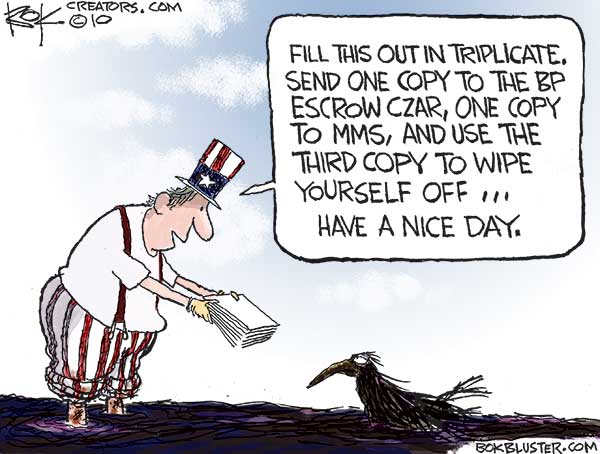
The BP gulf region oil spill has released a sticky substance has rendered pelicans, crabs and sea turtle immobile. There is also something sticky that has immobilized those who should be responding to this crisis: Washington bureaucracy. Efforts to minimize the damage have been thwarted by existing regulations, mindlessly applied to a situation where they are clearly inappropriate:
  • French oil skimmers offered to help with the clean-up, but were turned away because of the Jones act, a maritime protectionist measure that requires such work to be done by American labor;
  • The Oil Pollution Act of 1990 prevents U.S. oil skimmers from other parts of the country from being dispatched to the gulf; and
  • In an attempt to prevent the oil from reaching the shores, Louisiana governor Bobby Jindal wanted to build sand berms, but that solution was delayed by the Interior Department over concerns whether the sand berms would comply with environmental regulations.
What is particularly frustrating about their application of these regulations to the golf oil spill actually undermine the original purpose of these regulations. The Jones act was intended to preserve American jobs, and yet its application to the BP spill endangers large numbers of American jobs. And sand berms, a low tech barrier made of sand and hay, may have some negative ecological impacts, but can anyone seriously argue that the berms would do more environmental damage than a coat of oil on the Louisiana shores?

In an interview with "Today" show host Matt Lauer, President Barack Obama said, in defense of the federal response to this crisis
"I don't sit around talking to experts because this is a college seminar. We talk to these folks because they potentially have the best answers, so I know whose ass to kick."
The president caught some flack for the crudeness of his "ass to kick" remark. But there is a far more serious problem with this remark. Finding someone's ass to kick may be emotionally satisfying, but it does nothing to clean up the mess. To get this job done, the president should issue waivers to some of these regulations that are hampering the needed rapid response to this spill. Instead of asking whose ass to kick, the president should have asked "whose hands should we untie?"

Sunday, January 24, 2010

Charles Darwin Meets Adam Smith

"Orgel's Second Rule: Evolution is cleverer than you are."
- Francis Crick

"Now there's no more oak oppression,
For they passed a noble law,
And the trees are all kept equal
By hatchet, axe, and saw."
- From "Trees" by Neil Peart
Great ideas in one field of study are often variants of great ideas in another field. Consider the theory of evolution as developed Charles Darwin, the father of modern biology. According to the theory of evolution, each new generation of a species will include genetic variations. The vast majority of these variation will not help the organism to survive, and hence will quickly disappear. The rare variation that helps the organism survive, however, will be passed onto the next generation and will improve the species. The rich, vibrant ecological system we have today is the bi-product of the myriad of these variants that have occurred in Earth's history.

The process of evolution can seem wasteful and cruel: not only do most variants fail, but often once viable species become extinct due to competition from new species. But the destruction of less fit species is a vital part of the process, and the payoff of this process is huge.

The theory of Evolution has a striking resemblance to the free market concept as advocated by Adam Smith, the father of modern economics. In a free market economy, one is permitted to start a new business to provide a good or service. As with most biological variants, most new businesses fail. But the business that finds a better way to satisfy market needs will have a competitive advantage that will allow it to survive. As with evolution, a free market economy can seem cruel and wasteful, as many new businesses and even old established businesses go under. But this destruction is an essential part of the process of improving the economy. The fall of less fit companies is required to allow the next innovations to thrive.

The recently proposed "Financial Crisis Responsibility Fee" shows how poorly the work of Adam Smith (and evolution) is understood in Washington these days. The idea is being sold as a way for the taxpayers to get back the money they lent to the bankers for the recent bailout. The problem with this fee, however, is banks that have already repaid their loans with interest, and even banks that did not take any federal funds, will be required to pay this fee. In effect, the banks that managed the recent financial tsunami properly will be called on to cover the expenses caused by less well run banks. None of this "survival of the fittest" jazz here; D.C. has decided that all banks should be saved, whether they are fit or not.

To understand what is wrong with this proposal, consider what would have happened if the proponents of this proposal had been in charge of fixing the Earth's environmental crisis of 65 million B.C.E.
"Let me be clear: the major species of this planet, the Tyrannosaurus and Triceratops are too big to fail without causing the ecology to go into major collapse. There are those who say that we need to choose between saving these dinosaurs and allowing the new mammals to flourish. This is a false choice: the Earth can support both, as long as the new mammals follow sensible restrictions. I tell these new mammal species that there is a time for multiplication, but now is not that time. "
I'm glad this approach was not taken in the late Cretaceous period: the dinosaurs would still have gone extinct, and the world would now be poorer for this futile attempt to put off the inevitable. The proposed bank fee was a bad idea 65 million years ago, and it still is a bad idea today.

Tuesday, December 1, 2009

Dreams of My President

"War is the Health of the State"
- Randolph Bourne

"Even big politicians don't know what to do
Gracie doesn't know either, but neither do you,
So vote for Gracie!"

- "Vote for Gracie" sung by Gracie Allen

Tonight our president gave his long awaited speech on the Afghan war. In the next six months, 30,000 additional American troops will be sent to Afghanistan. Peace activists such as Michael Moore, Cindy Sheehan, and Tom Hayden have expresses their deep disapproval of this Afghan surge. After all, they supported Obama to end the wars. Wasn't Obama elected on a peace platform?

Well, not quite. During the 2008 campaign, Barack Obama actually supported the Afghan war. He fervently opposed the war in Iraq, and he may well have won based on his opposition to that conflict. But one of the Barack's most frequent arguments against the Iraq war was that it was diverting our efforts from the conflict we should be concentrating on, the Afghan war. He made his feelings on this issue quite explicit: this point was brought up in his televised debates with both Hillary Clinton and John McCain.

So how could these peace activists not remember the positions president Obama took just last year? It might be that Obama's rise was so fast that he was elected before having much of a track record. In the absence of said record, he became a political Rorschach test: people saw in him what they wanted to see. The peace activists dreamed of a President that opposed both wars, and Obama's anti-Iraq war rhetoric convinced them that Obama was the candidate of their dreams.

My sympathy for these peace activists is rather limited. Obama stated his hawkish position on Afghanistan rather clearly, and everything he said tonight is consistent with his 2008 campaign stand. They ignored what Barack said at their own peril; it is time for these dreamers to wake up.