"Orgel's Second Rule: Evolution is cleverer than you are."Great ideas in one field of study are often variants of great ideas in another field. Consider the theory of evolution as developed Charles Darwin, the father of modern biology. According to the theory of evolution, each new generation of a species will include genetic variations. The vast majority of these variation will not help the organism to survive, and hence will quickly disappear. The rare variation that helps the organism survive, however, will be passed onto the next generation and will improve the species. The rich, vibrant ecological system we have today is the bi-product of the myriad of these variants that have occurred in Earth's history.
- Francis Crick
"Now there's no more oak oppression,
For they passed a noble law,
And the trees are all kept equal
By hatchet, axe, and saw."
- From "Trees" by Neil Peart
The process of evolution can seem wasteful and cruel: not only do most variants fail, but often once viable species become extinct due to competition from new species. But the destruction of less fit species is a vital part of the process, and the payoff of this process is huge.
The theory of Evolution has a striking resemblance to the free market concept as advocated by Adam Smith, the father of modern economics. In a free market economy, one is permitted to start a new business to provide a good or service. As with most biological variants, most new businesses fail. But the business that finds a better way to satisfy market needs will have a competitive advantage that will allow it to survive. As with evolution, a free market economy can seem cruel and wasteful, as many new businesses and even old established businesses go under. But this destruction is an essential part of the process of improving the economy. The fall of less fit companies is required to allow the next innovations to thrive.
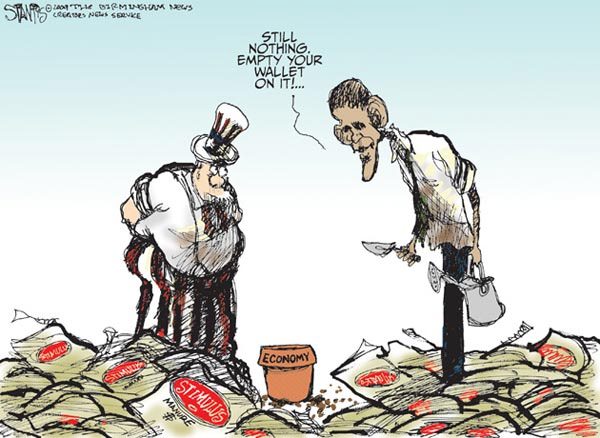
The recently proposed "Financial Crisis Responsibility Fee" shows how poorly the work of Adam Smith (and evolution) is understood in Washington these days. The idea is being sold as a way for the taxpayers to get back the money they lent to the bankers for the recent bailout. The problem with this fee, however, is banks that have already repaid their loans with interest, and even banks that did not take any federal funds, will be required to pay this fee. In effect, the banks that managed the recent financial tsunami properly will be called on to cover the expenses caused by less well run banks. None of this "survival of the fittest" jazz here; D.C. has decided that all banks should be saved, whether they are fit or not.
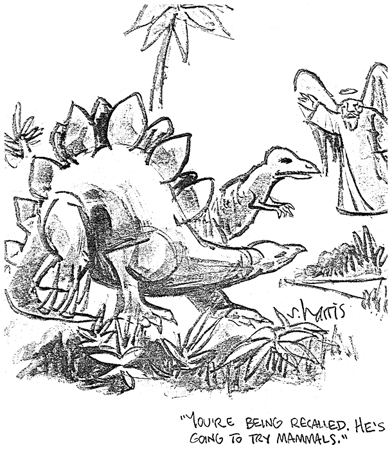
To understand what is wrong with this proposal, consider what would have happened if the proponents of this proposal had been in charge of fixing the Earth's environmental crisis of 65 million B.C.E.
"Let me be clear: the major species of this planet, the Tyrannosaurus and Triceratops are too big to fail without causing the ecology to go into major collapse. There are those who say that we need to choose between saving these dinosaurs and allowing the new mammals to flourish. This is a false choice: the Earth can support both, as long as the new mammals follow sensible restrictions. I tell these new mammal species that there is a time for multiplication, but now is not that time. "I'm glad this approach was not taken in the late Cretaceous period: the dinosaurs would still have gone extinct, and the world would now be poorer for this futile attempt to put off the inevitable. The proposed bank fee was a bad idea 65 million years ago, and it still is a bad idea today.