Friday, March 11, 2011

The Machinery of Egyptian Freedom


"Then said Jesus to those Jews which believed on him, If ye continue in my word, then are ye my disciples indeed; and you will know the truth, and the truth will set you free.”
- John 8:31-32
"Harmony and understanding
Sympathy and trust abounding
No more falsehoods or derisions
Golden living dreams of visions
Mystic crystals revelations
And the mind's true liberation
Aquarius...
Aquarius!”
- From "Age of Aquarius" by James Rado, Gerome Ragni and Galt Macdermot
Hosni Mubarak's brutal repression of protesters proved to virtually everyone except Vice President Joe Biden that he was a dictator. And like many dictators before him (Shah Mohammad Reza Pahlavi, Idi Amin, Bébé Doc, Ferdinand Marcos, Nicolae Ceaușescu, Augusto Pinochet and Mobutu Sese Seko, just to name a few), his own people forced his exit from power. But there is something extraordinary about the overthrow of Mubarak: he was forced out with very little real or threatened violence. In contrast to their government, the Egyptian protesters were astonishingly peaceful.

How did the protesters prevail without engaging in thuggery? The answer may be found in the 1973 book "The Machinery of Freedom" by David Friedman (son of economist and Nobel prize winner Milton Friedman). In this book, David Friedman makes the case for a much smaller government, replacing most forms of state coercion with voluntary arrangements. I learned a lot from this book, even though I do not subscribe to Friedman's rather extreme form of libertarianism. "The Machinery of Freedom" forces the reader to reflect on the assumptions we often make about the need for government power. No wonder that this book made Australia's Institute of Public Affairs list of 20 books that you must read before you die.

Two chapters of this book are quite apropos to the current middle east revolts. In "Revolution is the Hell of It", Friedman rejects violent revolution as a tactic to produce a libertarian state. Violence is counterproductive violation of libertarian principles. The final chapter, "How to Get There From Here", proposes a peaceful alternative to revolution: undermining the state's legitimacy. Even in the worst dictatorships, government power derives mostly from the majority of the population believing in the legitimacy of their leadership. They may dislike their leaders, but they think that only the current leaders can run their country, and that without these leaders, their nation would descend into chaos. As the Milgram experiments demonstrated, the pressure of group conformity can reinforce such a viewpoint. Friedman felt that an overbearing state could be reigned in through a combination of education and demonstration, convincing citizens that they can run their country without sacrificing their freedoms. As Lennon and McCartney wrote in the song "Revolution", "You better free your mind instead".

Is this recipe for peaceful overthrow of a tyrannical state too optimistic? I certainly thought so when first read this book. But consider what happened in Egypt. In a very short period, Mubarak's legitimacy vaporized. Shahira Amin, one of Nile TV' most popular journalists, abruptly quit because her network would only present government propaganda, a violation of her journalistic principles. In the days before Mubarak stepped down, there were a sizable number of policemen that refused to take action against the protesters. So somehow, the Egyptians pulled off Friedman's Utopian vision of how to end government repression.

I doubt that this kind of revolt could have happened in 1973. What made it possible today is a technical breakthrough: social networking. Earlier this year, an Egyptian blogger posted a video of police rape and torture of dissidents. And as Mubarak supporters learned, once a video hits the internet, it never disappears. This video, along with unrest in Tunisia, became popular Facebook topics. Opponents of Mubarak saw that they were not alone in their concerns. Facebook also turned out to be an excellent organizing tool. Recognizing the threat, the government tried cutting off internet access (is that the reason why there is talk in Washington about an internet kill switch?), but the dissidents found ways around this, including going back to dial-up access to foreign internet providers. So remember folks, don't throw away those 56K modems!

From the start of the Mubarak regime until shortly before his downfall, the various U.S. administrations have been solidly behind him. For that reason, it is hard to find an Egyptian protester with a positive word for an American Politician. There is an American, however, who is spoken of quite highly by these protesters: Mark Zuckerberg, founder of Facebook. If anybody gets a Nobel Peace Prize for the handling of the Egyptian crisis, it should be Zuckerberg, but unfortunately it will probably go to some politician instead. But history will remember that Facebook was a very important part in the Egyptian machinery of freedom.

Saturday, March 5, 2011

Crossing the Board Game / Electronic Game Divide


"You have to learn the rules of the game. And then you have to play better than anyone else."
- Albert Einstein

"I think it's wrong that only one company makes the game Monopoly."

- Steven Wright

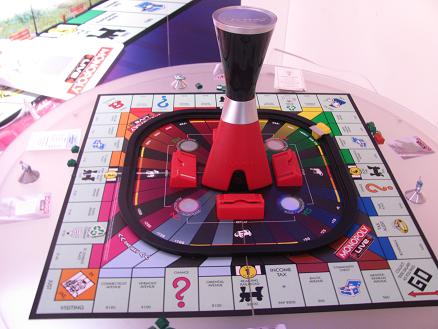
Video games have dominated the entertainment industry for the last few decades. The video games' older analog equivalent, the board game, has lost favor during this period. The number of board games sold last year was down 10% from the year before. In an attempt to reverse this decline, Hasbro will be releasing hybrid electronic / board games this fall. The first of these will be "Monopoly Live", followed by "Battleship Live".

The Monopoly Live board has a battery powered computer control tower at its center that guides the players through the game. Hasbro contends that this tower's guidance allows a new player to start playing right away without having to first study the rules. The tower provides the following services:
  • It takes on the thankless job of banker;
  • It computes taxes and mortgage fees;
  • It rolls the dice;
  • It reads the Chance and Community Chest cards (with appropriate sound effects);
  • It manages the money electronically (players have ATM cards); and
  • It runs additional games events such as auctions, horse races and tax audits.
A demo of Monopoly Live can be seen here.

Needless to say, there are purists who object to this merger of traditional gaming and electronics, defending the superiority of analog-based fun. Now I don't dispute that traditional board games can be a lot of fun. When I was a child, video games had not been invented, so my family had fun with classic board games Operation, Mousetrap, Monopoly, Life, Clue, Checkers, Chinese Checkers, and Bridge-It, as well as sadly forgotten games such as Careers and Masterpiece.

But even with these fond memories for the traditional board games, I do not reject the Live board game concept. First of all, the golden age of board games is overrated. When studying the history of a cultural phenomena, such as shopping malls, comic books, network TV, and even retro video games, one often ends up romanticizing the past. One tends to remember the successes and forget the failures. As one who lived through that era, I can vouch that for every classic board game, there were dozens of dull, uncreative games that were not worth playing once. Most of the worst board games were TV or movie tie-in games (The same thing could be said about video games). Our neighbors had a "Dick Tracy" game that was so bad, the only way we managed to have fun with it was to figure out how we could make a good game out of the game board and pieces. Note: if anyone knows of a ROM hacker who has succeeded in making a good video game out of a bad one, please tell us about it in the comments.

These "Live" games will not be the first time that electronics have promoted a board game. Two classic strategy games, Chess and Go, are probably more popular now than any time in history, thanks to the fact that one can play virtually any opponent on the planet in real time, using an internet connection. Computers almost certainly saved the game Othello from extinction. Othello is a much older game than most people realize: it was originally published as Reversi in nineteenth century England. For many decades after its invention, Reversi was known only to a small but enthusiastic group of strategy game enthusiasts. It was not until a PC version of the game, under the name Othello, that the game finally attracted a large following. There are Othello leagues in many nations, as well as international competitions. I doubt if you would be able to buy an Othello set at most game stores if it were not for the PC game.

Computers have made our work life much easier. Since the invention of the Monopoly game, file cabinets have been replaced by databases, typewriters have been replaced with word processors, checks have been replaced with electronic transfers, and postage meters have been replaced with E-mail. All of these changes allow us to do a better job with less effort. But if electronics can make our work life easier, why not use this same technology to make our gaming easier, especially since gaming is supposed to be a recreational activity?

Finally, keep in mind that the point of a board game, or any game for that matter, is to have fun, and these Live games look like they'll be a blast. I'm hoping they are working on a "Clue Live" where the tower gives voice to a detective that sounds like Basil Rathbone.

Sunday, February 20, 2011

Texas School Children: Give Choice a Chance

"Liberty, according to my metaphysics is a self-determining power in an intellectual agent. It implies thought and choice and power."
- John Adams
"Teach, your children well
Their father's hell
Did slowly go by
And feed them on your dreams
The one they pick's
The one you'll know by."
- From "Teach Your Children" by Graham Nash.
In this third and final post on the Texas school districts that discipline students using the legal system, I would like to focus on one incident from the Texas Appleseed report that exposes the root of many of the problems with American public education:
"A 17-year-old girl with autism became frustrated [in class]. The teacher who best understood how to manage her behaviors was off work that day. The substitute did not know how to respond and accidentally escalated the situation by talking loudly and getting close to the student. The young lady left the classroom without permission, cursed and then sat in the hallway rocking back and forth to calm herself. When the assistant principal heard what happened, he asked a police officer to write a citation for Disruption of Class. The young lady’s single, low-income mother came to the school to talk to the vice principal, explaining that her daughter did not have full control of her behavior and was not able to understand the citation. She also explained she could not pay for citations. The vice principal told the mom that if she did not want her daughter to get more citations, she should withdraw the daughter from school because she was old enough to drop out."
As the father of an autistic son, I find this incident especially appalling. One's first impression is to blame the vice principle for this injustice, but the problem goes beyond this one employee. True, the vice principle did not act in the student's best interest, but he did act in the school's best interest. But why does the school's best interest differ from those of the students? This perverse incentive system is a result of the lack of choice on the part of the student.

In most circumstances, most American public school students have no choice as to which school to attend. Moreover, school financing is generally based on the number of school aged children in the district, not on how many students actually attend the school. The school's budget is not negatively affected by their students switching to private education or home schooling.

We can empower student's families with a change to the way we finance public schools. Instead of allocating education money to the schools, we could these funds to the child, with additional public funds provided for students with special educational needs. The family would then choose which public school their child would attend, and then that school would receive the funding for educating that child. School that attracts more students would receive more financing, schools that loses students would be forced to tighten their belts. Under such a system, could you imagine a vice principle recommending that a student drop out?

Would the Texas system of legal fines for school offenses such a cursing, talking back and skipping classes be adapted in a school choice system? As we have seen, this system has been particularly harsh with racial minorities and the handicapped. These students would undoubtedly exercise their choice for a school that takes a more humane approach to discipline. No family would be forced to endure the Texas ticketing system.

School choice is not just an academic theory. It is practiced in Belgium, France, Sweden, Chile, Ontario, and New Zealand. The countries where choice has been tried get better student test results than American public schools, and get those results at lower cost. This is the unsurprising consequence of families choosing the schools that works best for their children.

When we buy a product like breakfast cereal or a laptop, we insist on having a choice between several providers in order to get the best product. And yet we settle for no choice in a much more important matter: the education of our next generation. Our children deserve better; they deserve a choice.

One final note: my autistic son Jonathan has his own blog, as well as his own YouTube account. He may be constrained by his condition, but that never stops Jonathan from making the most of what he can accomplish. This is what I admire most about him.

Friday, February 18, 2011

Texas School Children: Flex Your Rights!


"The right of the people to be secure in their persons, houses, papers, and effects, against unreasonable searches and seizures, shall not be violated, and no Warrants shall issue, but upon probable cause, supported by Oath or affirmation, and particularly describing the place to be searched, and the persons or things to be seized."
- Amendment 4 to the U.S. Constitution
"In 1787 I'm told Our founding fathers did agree
To write a list of principles For keepin' people free"
- From "Preamble", written by Lynn Ahrens for "Schoolhouse Rock"
This site's previous post discussed how some Texas school districts are now enforcing discipline using the criminal justice system. As noted in the Texas Appleseed report, this overly severe form of punishment poses a burden on poor families, is unfair to racial minorities, and adds to the already considerable challenges facing handicapped students. Is there any bright side to this criminalization of student behavior?

Yes there is. The ticketing of Texas students gives us an ideal platform to teach our children the importance of the U.S. constitution. Sadly, most adult Americans are quite ignorant of the workings of our democracy, especially our constitution. Civil libertarian Steven Silverman was shocked to discover how often people would unknowingly waive their constitutional rights, so in 2002 he founded the non-profit educational organization Flex Your Rights to educate the public on their constitutional protections. Flex Your Rights produced the video BUSTED: The Citizen's Guide to Surviving Police Encounters, which I heartily recommend.

Our schools have been doing a poor job of teaching the constitution. I would recommend that we work with the Flex Your Rights folks to develop a course on the constitution for Texas students. If the Texas school systems refuse to teach the constitution, perhaps Texan libertarians could present constitution lessons outside of school system (think of it as a Texan version of Dumbledore's Army). Armed with the Flex Your Rights curriculum, Texan students could both protect themselves from the excesses of the ticketing system and learn a valuable civics lesson in the process.

For example, the Appleseed report tells of a girl who was given a $200 ticket when a school officer searched her purse and found a cigarette butt. Had she known about the fourth amendment, she would have known that the search could almost certainly be prevented if she politely but clearly told the officer "I do not consent to a search of my purse". Unless the officer has a warrant for searching her purse, any search of her purse would be illegal, the cigarette butt could not be admitted as evidence in court, and the school officer could be be held liable for the illegal search.

The most effective learning technique is to learn by doing. Imagine what students would learn about civics by actually applying the Flex Your Rights curriculum for their own protection. This whole affair could have one really positive effect: a generation of Texas students with a full appreciation of our founding documents.

Wednesday, February 16, 2011

Texas School Children: Another Brick in the Wall


"I found one day in school a boy of medium size ill-treating a smaller boy. I expostulated, but he replied: 'The bigs hit me, so I hit the babies; that's fair.' In these words he epitomized the history of the human race."
- From "Education and the Social Order" by Bertrand Russell
"When we grew up and went to school, there were certain teachers who would hurt the children anyway they could
by pouring their derision upon anything we did
exposing every weakness however carefully hidden by the kids."
- From "Another Brick in the Wall" by Pink Floyd.

Bullying is major problem in many of our schools. Sometimes, the worst bullies are the grown-ups. A case in point is a novel form of discipline now practiced in several Texas school systems, including Houston, Austin, San Antonio and Dallas. Instead of detention to punish misbehaving students, the school system is using the criminal justice system. A student who disobeys a school rule is given a ticket that his or her family has to pay. Last year, more than 275,000 Texas juveniles were ticketed for such offenses as disrupting class, disorderly conduct or curfew violations (i.e. leaving campus without permission). These tickets are not cheap; when school officials searched a girl's purse and found a cigarette butt, she got a ticket for $200! Some troubled students can rack up several tickets, placing a substantial financial burden on their family.

These tickets have to be taken seriously. These violations are class C misdemeanors, which is serious enough to show up on a criminal record. Of course, a Texas child's criminal record should be wiped clean of these offenses once he or she turns 18, but due to the sheer volume of these tickets, this often isn't done. It gives a whole new meaning to the term "permanent record", doesn't it? Moreover, once a student turns 17, he / she can be arrested for failure to pay the ticket. This actually happened to a 17 year old student from Hidalgo county last year.

The public interest group Texas Appleseed has studied the ticketing of students. Among their findings were:

  • tickets were given to children as young as six;
  • racial minorities receive a disproportionate number of tickets; and
  • a student is much more likely to get a ticket if he / she has a disability.

What is especially appalling about this ticketing is that frequently no allowances are made for when a misbehavior might be caused by a disability. Tickets for using profanity have been given to students suffering from Tourette Syndrome! The Appleseed report has a particularly callous citation of an autistic girl. In the interest of full disclosure, I have an autistic son who has his own blog, making this sort of abuse even more disturbing to me.

All in all, this ticketing system recalls the protest song "Another Brick in the Wall" from Pink Floyd's 1979 Rock opera "The Wall". This song condemns the British school system of enforcing mindless conformity by humiliating any student that deviates from the norm. What better anthem is there for school systems that punishes students for the crime of being born with a disability?

So what should be done to stop this legal harassment of Texas children? I have two proposals that I will present in follow-ups to this post. Stay tuned.

A bonus video: here's a version of "Another Brick in the Wall" that might be more appropriate for Texas.

Saturday, February 5, 2011

Coffin Nails and Death Chic

"God's finger touched him, and he slept."
- Alfred Tennyson
"So do the dead, through the lights
The surfin' dead, oooh make it tight
The livin' dead now baby lose their heads
Now baby, doin' the dead"
- From "Surfin' Dead" by the Cramps.
On June 22, the Tobacco Control Act will require that cigarette packages carry larger, more visible warning labels. The FDA has proposed a set of new warnings, which will cover at least 50% of the cigarette pack's display area and portray the negative consequences of smoking in a rather graphic, shocking fashion.

The new labels have been challenged as a violation of property or free speech rights. I object to these labels for an entirely different reason: they are likely to backfire and make cigarettes more appealing. Given that humanity's greatest fear, it may seem surprising that anything can be made more appealing by associating it with the dirt nap. But the "Death Chic" phenomenon is very real, so these warning labels could make cancer sticks hip again.

To illustrate this point, consider the health crisis second only to smoking: the obesity epidemic. Certainly the owner of a grill would avoid any warnings that eating fatty foods like hamburgers could lead to heart ailments, right? Well, you'd think so, but think again. The Heart Attack Grill in Chandler Arizona makes it quite clear that its food is bad for you. It's not just the grill's name or its slogan ("Taste Worth Dying For"): the waitresses are dressed as nurses. The burgers come in three sizes: single bypass, double bypass, and quadruple bypass. Your order is identified by a hospital tag. And in spite of all these warnings, the grill has a large following. Fans from across the globe post to their Facebook page asking when a Heart Attack Grill will open in their country.

And what about that other addictive vice, alcohol? In the 90's, one of hottest vodka brands was "Black Death". Here is a bottle of Black Death in its promotional packaging; as you can see, the distillers have all the chutzpah of the Heart Attack Grill. Eventually, this product was forced off the market, but not by low sales. The regulators at the Bureau of Alcohol, Tobacco and Firearms were horrified by the product, and were even more horrified when the product was a hit. Unlike in the U.K., U.S. regulators never allowed the sale of "Black Death" vodka in its special dark glass, skull-shaped bottle.

In the popular arts, death sells everything from Heavy Metal rock, horror films, and even a cartoon series. So why are so many people attracted to embodiments of our greatest fear? Human behavior is rather complex, but there may be some simple explanations for death chic. Because death is so scary, facing death is a way of coming across as being totally bad-ass. Also, some of our current public heath campaigns have become so shrill that they come across as nagging. To many people, the campaign against obesity has definitely crossed into nagging territory, hence the popularity of the Heart Attack Cafe. It is a way of raising a pudgy middle finger to all the health experts who pester us about what we should eat.

So how do we avoid giving cigarettes an aura of death chic? First of all, don't use king size warning labels. The 50% size labels are the visual equivalent of shouting, and experience on internet forums indicates that shouting is frequently less effective than understatement. And forget the melodramatic "this product will kill you and every one you love for seven generations" messages. The warnings that are more likely to scare off potential smokers would basically say that buying this product makes you a real schmuck. Here are my recommended warnings:
  • Bought some cigarettes? Good luck finding a place where you can smoke them.
  • Warning: This product will force you to periodically leave your friends to smoke alone in the rain.
  • Warning: If you use this product, every cent you spent on cologne and teeth whiteners will be wasted.
  • Warning: If you buy this, you'll be paying way too much tax.
  • Warning: Being seen with this product will get you labeled as a creepy loser.
And finally, if we could get away with it, the most effective warning label of all would be:
  • Warning: The surgeon general has determined that smoking dramatically decreases your chances of getting laid.
After all, any Madison Avenue executive will tell you that sex sells, even more than death.

Friday, January 28, 2011

The Defeat of Anti-Tea Party Paranoia

"Yea, though I walk through the valley of the shadow of death,
I will fear no evil: for thou art with me; thy rod and thy staff they comfort me"

- Psalms 23:4
"I'm not afraid (I'm not afraid) to take a stand (to take a stand)
Everybody (everybody) come take my hand (come take my hand)"
- "Not Afraid" by Eminem.
In reaction to a major man-made tragedy, a frightened public will frequently lash out at some group associated with the perpetrator, victimizing many innocent citizens in the process. When an anarchist assassinated president McKinley, there was a mass arrest of anarchists, including those who rejected violence in any form. After the bombing of Pearl Harbor, we had a similar round-up of Japanese Americans. McCarthyism is another example: anger over Soviet infiltration of the State Department led to a backlash over anyone connected with the Communists, even if that connection was tangential or decades old. One decade ago, American Muslims suffered from the rage over the 9/11 attacks.

As tragic as the shooting Rep. Gabriel Gifford shooting was, we should be grateful that there was not a major retaliation against some group loosely associated with suspect Jared Loughner. Certainly there was an attempt to tar the Tea Party movement with this crime, but fortunately that effort failed.

The effort started with Pima County Sheriff Clarence Dupnik's assessment that Loughner was motivated by the Tea Party and talk radio. This assessment came out before he had any time to investigate, and this lack of investigation showed. Jared Loughner has a significant web footprint, and a quick web search would have shown that Loughner was no Tea Partier. For example, on his YouTube account, he lists the Communist Manifesto as one of his favorite books. In one of his videos, he gleefully shows an American flag burning. Does this sound like the work of a Glenn Beck fan?

The worst example anti-Tea Party paranoia I've seen is a Palm Beach post article by Jose Lambiet where he seriously argues against praising the neurosurgeon who saved Rep. Gifford's life in the hours after her shooting. Why doesn't this doctor deserve our praise? Because, says Lambiet, his parents donated money to Tea Party candidates! This is absurd on multiple levels. First of all, he is holding the children responsible for the actions of their parents; one wonders if he would chastise JFK because his father was a bootlegger. But even if the good doctor had donated money to a Tea Party candidate, so what? The tea Party members running for office are obviously trying to change the system through non-violent means. They may well be wrong on many of their political views, but they are still within their rights to express those views.

Fortunately, quick action by some of our leaders nipped this anti-tea party parania in the bud. Credit for this should go first and foremost to President Barack Obama, who stated within days of the shooting that it would be unfair to blame the Tea Party for the actions of this madman. Rachel Maddow also spoke against using this incident to attack the Tea Party, in spite of her disagreements with them. Conservative activist Lee Doren praised Rachel Maddow for her stance on this matter.

What makes Obama and Maddow's comments so helpful is that both were known for their opposition to the Tea Party, so the public knew that these calls for restraint are based on principle. That may well have staved off a major round of anti-Tea Party paranoia.

I'm not sure if this had any effect on the debate, but you should check out long time progressive activist and frequent candidate Ralph Nader's comments on the Tea Party. Unlike most on the left, he is excited by the election of Tea Party members, because they will actually be allies of the progressives on some important issues. That's right, Lee Doren praised Rachel Maddow and Ralph Nader praised the Tea Party; we better check to see if Hell has any winter snow alerts.