Tuesday, October 19, 2010

Government Greed

"Be on your guard against all kinds of greed; for one’s life does not consist in the abundance of possessions."
- Luke 12:15"

Money, so they say
Is the root of all evil today
But if you ask for a rise
It's no surprise
That they're
giving none away"
- From "Money" by Roger Waters
In many an economic debate, you will find one participant who feels that all our troubles can be boiled down to one word: greed. You've heard this argument before: greed is what drives the profit motive, the basis of free market economies, and that this dependence on one of the seven deadly sins accounts for all our society's ills, including oil spills, stock market crashes, and lousy "Star Wars" sequels. If I had a dime for every time someone given this one word diagnosis, I'd be, well, a successful capitalist.

This one word critique of free market economics is quite emotionally satisfying, but it does not hold up to scrutiny for a number of reasons. The world economic environment is extremely complex, and one word diagnoses generally do not apply to systems more complicated than a food processor. The greed critique of the private sector also seems to make the assumption that, in the absence of profits, people behave in a less greedy fashion. But a number of recent news stories confirm that the public sector succumbs to greed at least as often as the private sector.

For example, many cities and towns use special cameras to ticket drivers who run red lights. These are there for our safety, or so we are told. But multiple studies have recently shown that red light cameras actually increases accidents. When drivers spot the cameras, they frequently slam on the brakes, and this causes more accidents than are prevented by the cameras. In fact, a Dutch city has discovered that they can decrease accidents by a re-design of their roads that does not use traffic lights at all. So how many cities have dropped the red light cameras in light of these studies? Whenever this question is posed to city officials, it is amazing how quickly the topic is changed from safety to how could we possibly replace the lost ticket revenue. So are these cameras used because of safety, or because of greed?

Consider the recent pay scandal in Bell, California, a small, lower middle working class suburb of Los Angeles. The median family income in Bell is only $30,504, but the city residents pay some of the highest property tax rates in the country. When city officials insisted that these taxes needed to be raised even further to keep the city solvent, investigative reporters looked from the L. A. Times looked into city finances. They found that Bell was dramatically overpaying its officials. The Bell police chief earned 33% more than the police chief of Los Angeles. The city manager's base salary was $800,000, almost twice as much as what we pay the president of the United States, and bonuses and other benefits raised his total compensation for last year to $1.5 million dollars. To the poor, over-taxed families of Bell, this looks like greed.

Another case to ponder: in 1992, Massachusetts passed a ballot initiative to increase tobacco taxes, and to use the additional revenue for tobacco prevention programs. Starting in 1993, the state had created an effective anti-smoking ad campaign. The most popular of these ads featured the saga of Pam Laffin, a young woman who was dying of emphysema. The ads traced her various diagnoses, her vain attempt to get a lung transplant, and finally her death that left her two young daughters without a mother. The ads had quite an impact: the number of smokers in the state dropped off faster than the national average. And yet, this successful ad campaign dropped less than a decade later.

Now why did the state drop a program that was actually helping smokers quit? Too expensive, of course. Forget the promise to voters that the tobacco tax money would go to tobacco prevention, the legislators decided that they had better uses for the money. Don't worry that the tobacco tax is highly regressive, for smokers are a politically unpopular group. When tobacco companies benefit from the unhealthful addiction of smokers, we call that greed. So when the state over-taxes these same smokers, why isn't that greed?

These and other examples of government avarice show that the public sector effort to eliminate greed is about as successful as the Puritan effort to eliminate lust. It's not clear if , greed is an integral part of human nature. It is not an issue of whether "Greed is good", the main point is that "Greed is". One virtue of free markets is that they harness greed to some positive ends. For all the moral posturing, It was greed that propelled the tremendous improvements in our PC's (Moore's Law), in our cars, and in our home entertainment (from LP's to CD's to MP3's, from VHS to DVD to Blue Ray).

So the next time you hear someone sanctimoniously boiling down a complex issue to one word ("Greed"), feel free to accuse him of one of the other deadly sins: sloth.

Friday, September 10, 2010

Homeopathy! Apply Directly to the Recession!

"Insanity: doing the same thing over and over again and expecting different results."
- Albert Einstein
"[Groucho] My diagnosis never fails,
I know just what to do,
Whenever anybody ails,
I'm sympathetic too,
My heart within me melts...
[choir] His heart within him melts...
[Groucho] No matter what I treat 'em for,
they die from something else."

- From "Dr. Hackenbush", by Bert Kalmar and Harry Ruby.
A close examination of seeming unrelated topics often reveal some surprising connections. For example, the other night I was looking at youtube videos featuring James Randi, the famed magician and debunk-er of pseudoscience. One of Randi's more popular videos was his explanation of homeopathy, a form of medical quackery that produce the headache medicine Head-On, promoted by one of the most annoying TV commercials of all time. One of the basic principles of homeopathy is the law of similars, which holds that substances that cause healthy people to get symptoms can cure diseases that have these symptoms. For example, a homeopathic cure for a headache would be based on a substance that would induce the a headache in a well person. Who knows, maybe Head-On would work better if its ingredients included a portion of the Head-On ad.

Dr. Stephen Barrett, expert on medical quackery, dismisses the law of similars as a form of "sympathetic magic" without any scientific basis. In the interest of fairness, arguments for homeopathy can be found here.

Both James Randi and Dr. Barrett make a convincing case that the law of similars is rather silly. But the very night I saw the Randi video, I read this Bloomberg opinion piece on the Frank-Dodd housing reform bill. The author of this opinion piece, mortgage finance consultant Edward Pinto, criticizes the bill's list of criteria for prudent underwriting for not including a required minimum down payment nor a good credit history. It is easy to see the political motive for this bill; there is considerable pressure to increase home sales. But wasn't the current housing crisis caused by watered-down lending requirements that caused homeowners to take on excessive risk? The Frank-Dodd bill is basically applying the law of similars applied to the housing market: the policies that produced a downturn in a healthy economy will reverse the downturn in a recession. This is economic homeopathy, and hence economic quackery.

Why do people fall for medical quackery? All too often, the victims of medical frauds suffer from ailments for which there is no remedy. That is a hard prognosis to accept, and hence patients will accept any other alternative, no matter how shaky its scientific foundation.

The same can be said about why voters fall for economic quackery. Many home owners desperately want housing prices to return to the level they were at the height of the bubble. But it is unrealistic to expect housing prices to go that high again, since they far exceeded the value of the house. The cold, hard truth is that there is little that can be done to avoid the economic pain caused by our past mistakes. And no, the pain will not be lessened by an application of Head-On.

For more on the causes of the recession, I strongly recommend the documentary "Overdose: The Next Financial Crisis". In order to understand how the current financial crisis came about, the film makers talked to those few economists who foresaw the housing bust. These same economists warn that our current financial remedies will lead to another, even worse crisis.

Sunday, August 29, 2010

The Dismal Science, Gangsta Rap Version


"We are all Keynesians now."
- President Richard M. Nixon

"We’ve been going back and forth for a century
[Keynes] I want to steer markets,
[Hayek] I want them set free
There’s a boom and bust cycle and good reason to fear it
[Hayek] Blame low interest rates.
[Keynes] No… it’s the animal spirits"
- From "Fear the Boom and Bust" by John Papola & Russ Roberts
Our anemic economy has dominated the news of late, and will almost certainly be the central issue in the November elections. In spite of record stimulus spending, we still have nearly 10% unemployment and sagging housing sales. The debate over this crisis centers around two economists of the previous century, John Maynard Keynes (1883-1946) and Frederic A. Hayek (1899-1992).
  • In the book "The General Theory of Employment, Interest and Money", Keynes argues that in times of economic downturns, government spending must increase in order to boost aggregate demand.
  • Hayek, Nobel prize winner and author of the 1944 best seller "The Road to Serfdom", argued that excessive government spending could make things even worse by creating perverse incentives and blunting price signals.
Voters would greatly benefit from an understanding of these two great economists. Elites often lament that far too few voters have an appetite for scholarly treatises on topics such as economics, preferring instead to indulge in pop culture. How could Hayek and Keynes possibly compete with "Dancing with the Stars"?

What about combining economics with pop culture? This unlikely idea occurred to fledgling television producer / directors John Papola and Russ Roberts. Concerned about the current downturn, Papola felt that it was important to get these ideas to a wider audience. Papola and Roberts considered several popular culture renditions of the ideas of Keynes and Hayek, finally settling on a rap video. The resulting video, "Fear the Boom and Bust", has been views 1.3 million times on YouTube. It has been translated into Spanish, French, Japanese and Chinese. Economics professors across the globe have shown this video to their classes. The producers have received kudos from both noted Keynes biographer
Robert Skidelsky and rapper Kei$ha.

See http://www.econstories.tv for more about this remarkable video that demonstrates that popular culture can actually promote learning.

Saturday, July 3, 2010

Taking The Pledge


"I pledge allegiance to my flag and to the Republic for which it stands, one nation indivisible, with liberty and justice for all."
- Francis Bellamy, "Pledge of Allegiance" (original version)
"I pledge allegiance to the flag of the United States of America and to the republicans for Richard Stands, one nation invisible, with liberty and just us for all."
- The "Pledge of Allegiance" as many school children remember it
Massachusetts state law requires that teachers lead their class in the "Pledge of Allegiance" every day. The courts have ruled that a teacher or a student's right to choose not to recite the pledge is protected by the first amendment of the constitution, so the law has fallen into disuse. Every few years, some sort of drive pops up to bring back the recitation of the pledge in schools.
Now an Arlington teenager is spearheading such a drive.

Most of the challenges to the pledge have been on religious grounds. The words "under God" were added to the pledge in the 1950's, raising establishment clause issues. In courts, defenders of the pledge have argued that these words do not favor any particular religion, since followers of any faith can interpret the phrase "under God" to be the god of their faith. This argument ignores the rights of atheists and agnostics, as well as those religions that are not centered around the worship of one deity. What would the phrase "under God" mean to a Buddhist, a Confucian, or a Taoist? And for a Hindi, which god does the pledge refer to?

Advocates of reviving the school-led pledge assure us that no student or teacher will be forced to take the pledge. But the history of the commonwealth of Massachusetts suggests otherwise. In 1984, Randolf high school senior Susan Shapiro, an orthodox Jew, objected to the pledge. She believed that pledging to an inanimate object (the flag) would be a form of idolatry. Her home room teacher berated Susan for her beliefs in front of the class. Later she found herself bullied by her fellow students, and her family started receiving anonymous threatening, and often anti-Semitic, phone calls. Eventually Susan received police protection. These were the consequences of a student declining to take a pledge that was promoted as "voluntary".

Although most critiques of school-led pledging center around religion, the strongest critique of this proposal, ironically, comes from the pledge of allegiance itself. The pledge concisely but eloquently expresses why our country deserves our allegiance in its final six words: "with liberty and justice for all". Our children should learn how valuable liberty is, how rare the freedoms we enjoy today are in human history, and why this nation's founders fought so hard for it. But what would witnessing fellow students being pressured to recite a pledge against their will teach a child about liberty?

All too often, these mass rote recitations of the pledge result in children mouthing the words without really understanding them - witness the generations of kids who thought the pledge had something to do with "Richard Stands". At its worst, this ritual can deprive a student of his or her freedom, ironically in the name of a pledge about liberty. Let me suggest an alternative: why don't we have our grade school and high school curriculum include one week where the students learn about liberty? Our schools should have an annual "Freedom Week" where the students will be taught how liberty played a vital role in virtual every subject they are studying, including history, science, music and literature. There are dissidents who have come to this country to escape repression who would make excellent "Freedom Week" lecturers. If we could really impress our children with the importance of freedom, they would gladly and voluntarily pledge to this country.

Friday, July 2, 2010

Black Gold And Red Tape

"A bureaucracy always tends to become a pedantocracy."
- John Stuart Mill, "On Representative Government"

"Bureaucracy is the epoxy that greases the wheels of progress."
- James H. Boren, "When in Doubt, Mumble: a Bureaucrat’s Handbook"
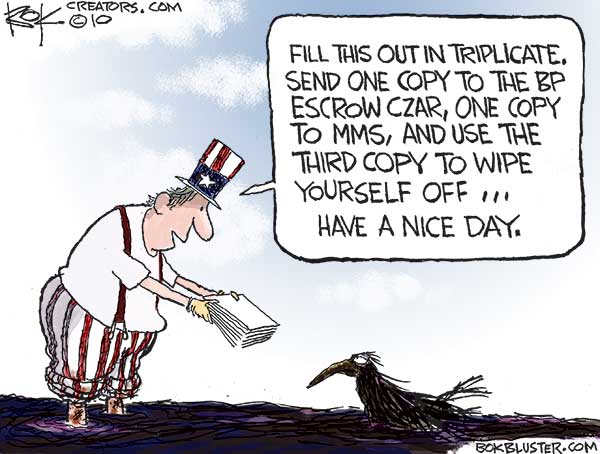
The BP gulf region oil spill has released a sticky substance has rendered pelicans, crabs and sea turtle immobile. There is also something sticky that has immobilized those who should be responding to this crisis: Washington bureaucracy. Efforts to minimize the damage have been thwarted by existing regulations, mindlessly applied to a situation where they are clearly inappropriate:
  • French oil skimmers offered to help with the clean-up, but were turned away because of the Jones act, a maritime protectionist measure that requires such work to be done by American labor;
  • The Oil Pollution Act of 1990 prevents U.S. oil skimmers from other parts of the country from being dispatched to the gulf; and
  • In an attempt to prevent the oil from reaching the shores, Louisiana governor Bobby Jindal wanted to build sand berms, but that solution was delayed by the Interior Department over concerns whether the sand berms would comply with environmental regulations.
What is particularly frustrating about their application of these regulations to the golf oil spill actually undermine the original purpose of these regulations. The Jones act was intended to preserve American jobs, and yet its application to the BP spill endangers large numbers of American jobs. And sand berms, a low tech barrier made of sand and hay, may have some negative ecological impacts, but can anyone seriously argue that the berms would do more environmental damage than a coat of oil on the Louisiana shores?

In an interview with "Today" show host Matt Lauer, President Barack Obama said, in defense of the federal response to this crisis
"I don't sit around talking to experts because this is a college seminar. We talk to these folks because they potentially have the best answers, so I know whose ass to kick."
The president caught some flack for the crudeness of his "ass to kick" remark. But there is a far more serious problem with this remark. Finding someone's ass to kick may be emotionally satisfying, but it does nothing to clean up the mess. To get this job done, the president should issue waivers to some of these regulations that are hampering the needed rapid response to this spill. Instead of asking whose ass to kick, the president should have asked "whose hands should we untie?"

Friday, June 18, 2010

2010: The Year of Voters Behaving Badly


"If the ruler is upright, the people will do things without being ordered; if the ruler is not upright, even though he orders people to do something they will not comply."
- Analects of Confucius
"There's something wild about you child
That's so contagious

Let's be outrageous
--let's misbehave!!!"

- "Let's Misbehave" by Cole Porter.
The June 8th South Carolina Democratic senatorial primary is an important harbinger of the fall elections. Vic Rawl, the candidate supported by most of the Democratic party leaders, was expected to handily win the nomination. In a stunning upset, Rawl lost in a landslide to Alvin Greene, an unemployed veteran who did no fund raising, virtually no conventional campaigning, and whose campaign had neither a twitter account nor even a website. How could this happen?

Greene insists that he won with old fashioned stumping, driving across the state and meeting with the voters. As appealing as this explanation is, Greene does not appear to have the charisma to pull this off in his post-primary interviews. Some S.C. Democrats speculate that Greene is a Republican plant. This seems unlikely for a number of reasons. Pollsters agree that Senator Jim DeMint will almost certainly win re-election. Why would the S.C. Republicans take the risk of cheating when they can win honestly? Also, the only outside support that Greene allegedly received was the payment of his filing fee. If some conspirators came up with that fee, why didn't they back up their investment with some campaign funds? But more importantly, even if Alvin Greene were a plant, why did nearly 60% of S.C. Democratic voters pull the lever for him?

The answer is as simple as it is troubling for the major political parties. South Carolina voters resented the idea of anointing the Democratic leadership pick of Vic Rawl, and they resented it so much that they were willing to pick any other name on the ballot, even if it was someone they never heard of. This is part of a trend this year: voters in this year's primaries and special elections are refusing to follow the unwritten rules of behavior.
  • The special election to fill late Senator Ted Kennedy's seat was widely expected to be over with the Democratic party primary. Conventional wisdom said that solidly Democratic Massachusetts would never replace the late senator with a Republican. Conventional wisdom was wrong; Republican Scott Brown won that race.
  • In the Utah Republican senate primary, the party leaders lined up behind the incumbent Senator Bob Bennett. The Republican voters of Utah disagreed, deciding that they preferred a newcomer over their sitting senator.
  • Much of the Democratic establishment, including the President, welcomed Senator Arlen Spector into their ranks and endorsed his bid to be the Pennsylvania Democratic nominee. A group of liberal Democrats disagreed, and successfully defeated Spector's nomination.
  • In Arkansas, local labor groups ignored pleas from the national party and President Obama and campaigned against the re-nomination of Rep. Blanche Lincoln. Lincoln just barely won the nomination, but the aggressive primary fight has made her defeat in the general election an almost certainty.
This trend cuts across both party and ideological lines. Voters of all stripes are refusing to obey the unwritten rules. What has made this year's voters so ornery?

Maybe the problem could be traced to our leaders. After all, they also have unwritten rules. How good have they been at following them? Let's take a look at the Republicans. The rules say that the Republicans will avoid foreign entanglements, support free markets, cut excessive regulation and reduce deficits. For six years under the previous administration, Republicans held the presidency and a majority in both houses, and in those years:
  • We entered two wars that have no clear end date;
  • Congress enacted the most strongly protectionist policies since the Hoover administration, including high steel tariffs and farm subsidies;
  • From 2001 to 2007, our supposed de-regulators actually added another 13,652 pages of regulations to the Federal registry; and
  • By any measure, the federal deficit rose to a historic high.
It is interesting to note that on several of these issues (free trade, deregulation, balancing the budget), the Clinton administration had a better record of following the Republican rules than the Republicans did!

Now let us take a look at the Democrats. The rules say that Democrats will bring the troops home, counter corporate influence over our government, reign in executive power, and protect our civil liberties. Well, let's look at the record:
Given the Obama record, it is no surprise that Daniel Ellsberg, the man behind the Pentagon Papers, said in a recent Der Spiegel interview
"I think Obama is continuing the worst of the Bush administration in terms of civil liberties, violations of the constitution and the wars in the Middle East."
The question is not why voters are so contrarian this year. The real mystery is why voters have been so obedient for so long. As Confucius taught us more than two thousand years ago, politicians will see better behavior only after they model better behavior themselves. In the mean time, voters will continue to reason that "If our leader won't follow the rules, why should we?"

Saturday, June 5, 2010

The Nomi Song Will Set You Free

"I CELEBRATE myself, and sing myself,
And what I assume you shall assume,
For every atom belonging to me as good belongs to you."
- "Song of Myself" by Walt Whitman

"I'm young and I love to be young
I'm free and I love to be free
To live my life the way I want
To say and do whatever I please"
- "You Don't Own Me" by Leslie Gore
Klaus Nomi was one of the most talented Rock vocalists of all time, and certainly the one of most eccentric. His career was remarkably brief: he died on August 6, 1983, only two years after the release of his debut album. But the impact of his short tenure on the world stage nearly 27 years ago can still be seen in current culture and society.

Klaus was a leading light of the new wave movement in the late 1970's / early 1980's. This was an era when rock music was big business, and recorded music was the most profitable sector of the entertainment industry. But many artists felt that the obvious commercial success of the music industry was masking a serious problem: rock music was becoming standardized, dull, and formulaic. The rock genre needed new, fresh ideas in order to survive. In 1978, some young artists in New York devised a way to develop these new ideas by reviving an old idea: vaudeville. They staged a review called "New Wave Vaudeville" where performing artists of all stripes could try out their innovations before a live audience.

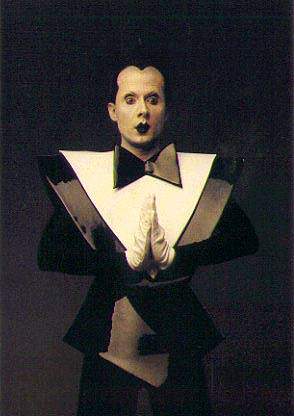
Enter Klaus Sperber, a West German counter tenor who had done some performing in Avant Garde theater. For the New Wave Vaudeville, he put together a rock act under the name Klaus Nomi. The act portrayed him as an visitor from another planet. He appeared on stage with a costume and make-up inspired by 1920's Dadaist theater, and with a hairstyle that actually emphasized that he was going bald. His set consisted of New Wave songs, classic rock songs, old standards like "Falling in Love Again", and his first love, opera. His stage persona was openly gay at a time when that was still controversial. Well, they said they were looking for something different, and Klaus Nomi definitely delivered. Nobody could mistake him for Eddie Money. As a vaudeville insider put it, "He was the wrong man, doing the wrong thing, at the wrong time". So naturally, he was the hit of the show.

His unusual background actually served him well in his role of rock singer. His opera training gave his voice phenomenal range and control. He also imparted a certain emotional intensity to every song he did, and his unique approach to his music provided us with a fresh look to even the most familiar of songs.

For example, Nomi did a cover of Leslie Gore's 1964 hit, "You Don't Own Me". Hailed as a feminist anthem, this song's lyrics are a girl's declaration of independence from a domineering boyfriend. Typically, when a man sings a song written for a woman, the gender references are swapped. Klaus sang the original lyrics, including the lyric "Don't say I can't go with other boys". In fact, when he gets to that line, he defiantly emphasized the word "boys". In short, he turned this feminist anthem into a gay pride anthem.

This song was seen as quite liberating by straight audiences as well as gay. This is in part because all of us, at some time or another, are burdened by social pressure. Nobody is a perfect match for societal norms, and hence everybody can sympathize with a square peg being hammered into a round hole. And that is what makes Nomi's cover of "You Don't Own Me" so joyous: in a world where this ultimate non-conformist can proclaim his freedom is a world where we can all be free.

After the New Wave Vaudeville, Klaus developed a devoted following in New York, and was very well received in Europe. He signed a contract with RCA. His debut album may be the only record that has both a song written by Chubby Checker and an aria written by Camille Saint-Saƫns. He seemed well on his way to making it big when he contracted AIDS. He became one of the first celebrities to die of the disease, passing away years before either Liberace or Rock Hudson.

In spite of his tragically early demise, Nomi continues to attract new generations of fans through some appropriately unconventional channels. The hipsters who produce the Adult Swim show "The Venture Brothers" included Klaus as a supporting character. More surprisingly, Nomi got a boost from conservative icon Rush Limbaugh. Rush uses Nomi's "You Don't Own Me" as one of his update themes, and this has spiked interest (and sales) among conservative republicans.

It may seem strange the same political movement that gave us the infamously anti-gay 1992 Family Values convention is now listening to the music of Klaus Nomi. I would argue that Klaus Nomi actually represents what the Republican party is supposed to be about far better than the 1992 convention did. After all, if the Republicans are serious about the principles of promoting limited government and individual liberty, what better spokesman could they have than Nomi?

The 2004 documentary of Klaus Nomi's life and career, "The Nomi Song" is now available online, and I heartily recommend it. If nothing else, catch the end of the film. The film makers have a very clever, almost magical and surprisingly upbeat way to wrap up his life story.